Wednesday, November 11, 2015

Canada Bereft: In the right place

The Canada Bereft statue at the Vimy Memorial in France is also called Mother Canada and sometimes, Mother of Canada. She looks bereft and you can feel sad just being near her.

“Mother Canada” or “Canada Bereft”: A female figure draped in a cloak stands alone on the wall at the north-eastern side of the memorial. She bows her head and is looking down at a stone sarcophogus, representing Canada's war dead, at the base of the 24 foot (7.3 metres) wall below her. The magnificent view across the Douai plain and the location of the old enemy of the time spreads out before her. This figure is called Mother Canada or Canada Bereft, representing the nation of Canada mourning for her dead. The figure was carved from a single 30 tonne block of limestone.

The memorial is vast and she is very much to scale. She's overwhelming only in the compassion she engenders.

Compare her to this:

This is the statue – also called "Mother Canada" – proposed for Green Cove in Cape Breton Highlands National Park. It is the subject of much controversy not least because it's so ugly – a monstrosity, it's often called. It's also planned to be located in a National Park and it's a blatantly commercial venture, masquerading as a site to honour Canadian soldiers who didn't come home from the wars.

Those are all legitimate reasons to shut down this awful project and there's another good one. The statue in France stands in the middle of a battlefield. She's surrounded by graveyards and numerous reminders of the tragedies she's mourning. She's part of something much larger than herself.

She's so moving because she's in the right place.

And let me add this assurance – with definite reference to the commercial plans for the monstrosity – there is no Canada Bereft Gift Shop anywhere in sight.

Tuesday, November 10, 2015

In Memory of Their 60,000 Dead . . .

I don't know if I really buy the mythology about Vimy Ridge – the often-quoted assertion that the battle was a defining moment for Canada, "when the country emerged from under the shadow of Britain and felt capable of greatness." It sounds a bit romanticized to me, the kind of emotion I try to avoid when looking at wars.

But it doesn't really matter what I think about it. The Battle of Vimy Ridge is a major part of our history. I've known veterans of that battle – gone now, of course – and as we so often do when we look back, I wish I had asked more questions about it. I wish I had known which questions to ask.

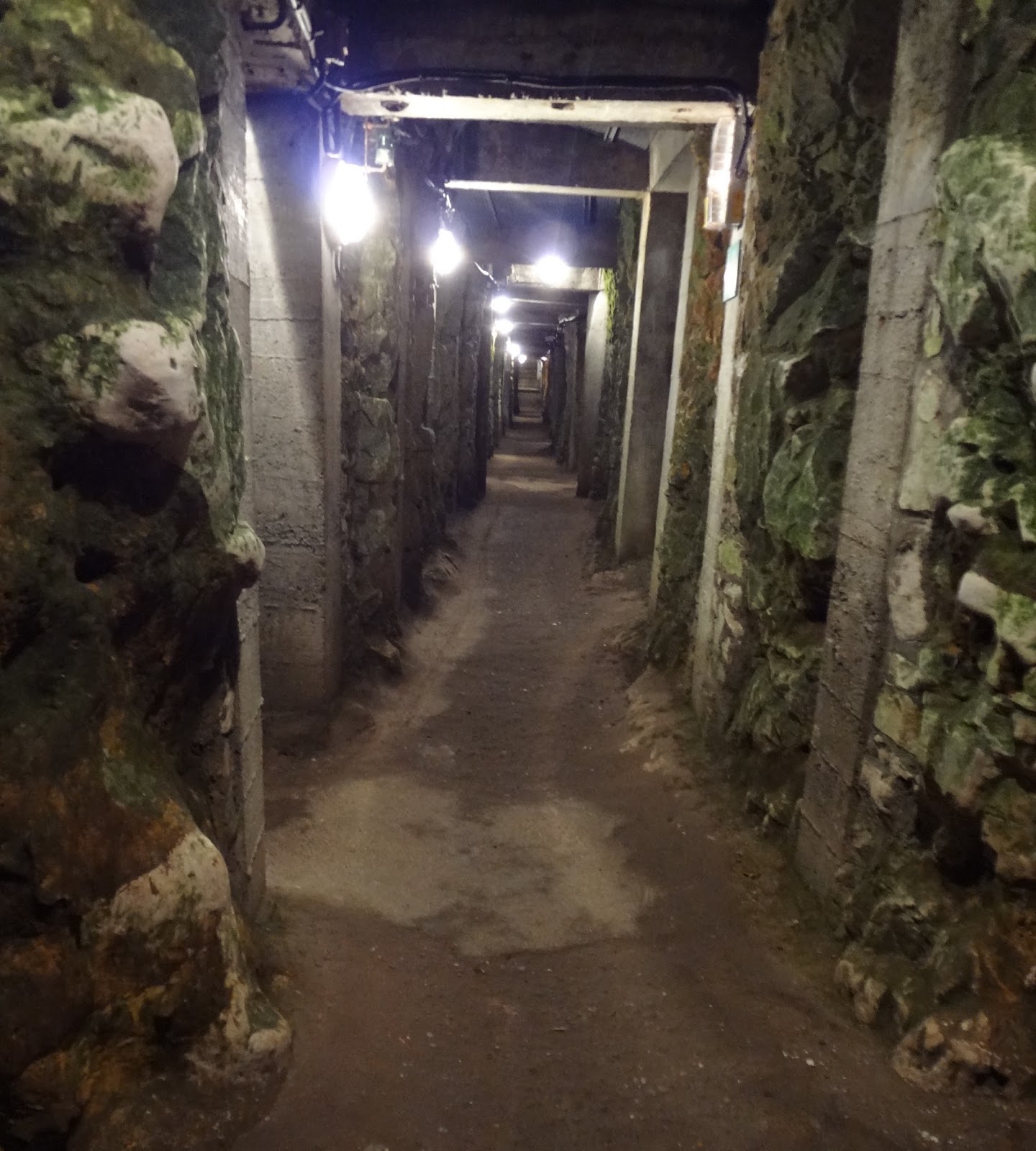
We visited the Vimy battlefield a few weeks ago. As always – as I've described here – I can't imagine the scene as it must have been. I can't imagine it because I can't conceive of it.

It looks like this now. We know it didn't look like this then.

It's a very peaceful site which seems appropriate. People are quiet. You get the impression they're trying to absorb the history that surrounds them. But maybe I'm reading too much into the atmosphere.

I've seen lots of pictures of the cemeteries – you have too – but I'm not sure any number of pictures can prepare you for the endless fields of graves – not only the Vimy cemeteries but the cemeteries that cover miles and miles of surrounding countryside.

The Vimy Memorial is instantly recognizable and is as impressive as everyone has told you. It's very very big; it dominates the surrounding landscape and commands careful attention from all sides. It's made up of many sculptures, all of them with symbolic – mostly religious – meaning.

The Canadian Memorials are all seen to be expressions of grief and mourning unlike some of the national monuments which are seen to depict triumph and victory. In keeping with the religious imagery,

"the figure of 'Canada mourning her fallen sons' makes a clear reference to traditional images of the Mater Dolorosa (the Virgin Mary in mourning)."

Most of the people I knew who served in the wars didn't talk about it – not about the bad stuff. We have to try to understand it outside the history books through the trenches, the tunnels, the exhibits, the graves, the memorials. It's a representation of history, an album of pictures that's put been put together with love and respect and with much dignity. There's an air of sadness all around but enduring the sadness is surely the least we can do.

Monday, November 9, 2015

Peace be with you

The Women in Black (London) hold a vigil every Wednesday from 6:00 p.m.-7:00 p.m. around the statue of Edith Cavell, just near St Martin's church and Trafalgar Square. They've rarely missed a Wednesday since 2003. It was Wednesday when we happened to be walking in that neighbourhood on our recent trip to London and we saw the women there.

Women in Black is a world-wide network of women committed to peace with justice and actively opposed to injustice, war, militarism and other forms of violence.

When I saw the Women in London that day, I remembered the times I stood with the Women in Black in Halifax, in front of the Old Halifax Library. The vigils were silent. We simply stood there, holding placards, handing out the material we'd brought along.

The one I remember most clearly was as the First Gulf War was beginning in 1990.

Early on the morning of January 17, 1991, a massive U.S.-led air offensive hit Iraq’s air defenses, moving swiftly on to its communications networks, weapons plants, oil refineries and more. The coalition effort, known as Operation Desert Storm, benefited from the latest military technology, including Stealth bombers, Cruise missiles, so-called “Smart” bombs with laser-guidance systems and infrared night-bombing equipment. The Iraqi air force was either destroyed early on or opted out of combat under the relentless attack, the objective of which was to win the war in the air and minimize combat on the ground as much as possible.

It's always difficult to be a pacifist in Halifax but particularly so when a new war is getting underway. We were called some very unpleasant names as we stood quietly.

I went into my archives to see what I might have written at that time about fighting for peace in a time of war. I was a columnist with The Daily News and this, in part, was one thing I wrote around that time:

I find it disheartening that the people who are anti-war, the people who work actively for peace have been put into a position where they feel almost apologetic about their opinion.

In order to avoid complete alienation from neighbours and acquaintances, some people who are for peace feel they must preface their every anti-war statement with something about supporting the troops: "I'm against the war but I support our troops, I'm proud of our boys and girls serving their country."

The other obligatory remark for people who speak against the war is a denunciation of Saddam. You have to acknowledge that you know how bad he is ("Many things are true even if George Bush says them," writes author Todd Gitlin in The Village Voice.) So you have to say, "I agree Saddam is a monster but..."

The question we should be asking ourselves is: how have we come to this? Where has this upside-down world come from, where values are so screwed up that it has become impossible to say you're against the war simply because you believe war is wrong.

Why has the use of war to settle international conflicts become the norm and people who oppose war have become The Other – marginalized by society?

Peace activists are harassed on the streets and called "traitor." Anti-war demonstrations are ignored or played down by the media. The people who march are portrayed as pie-in-the-sky dreamers or old hippies. Censorship is accepted with nary a whimper of protest. News reporters who normally talk about "objectivity" as if it were a sacrament, suddenly pepper their reports with "we" and "they."

All this because, all facts aside, at some deep and primal level, war is seen to be noble. It's usually mentioned in the same breath with democracy, freedom and God. To be against it then, is to be against democracy, freedom and God.

So you can be in favour of the war – just because. But if you're against the war, you'd better be prepared to qualify it, justify it, and apologize for it. Even still, you'll be a pariah.

Friday, November 6, 2015

The long memories of Ypres

I'm not comfortable mythologizing the wars. I'm always a little worried that we're still, on some level, celebrating and living the wars vicariously through sad memories. It's a fine line we walk to honour those who were there while trying to separate them from the immoral circumstances that sent them there.

The official memorials along the Western Front manage this well, avoiding morbidity and mawkishness and expressing true grief.

One of the most moving memories we have of Ieper (Ypres) in Belgium was our visit to the Menin Gate. It's one of four British and Commonwealth memorials to the missing in the battlefield area of the Ypres Salient in Belgian Flanders. The memorial bears the names of 54,389 officers and men from United Kingdom and Commonwealth Forces (except New Zealand and Newfoundland) who fell in the Ypres Salient before 16th August 1917 and who have no known grave.

The names of Canadians lost here are overwhelming to a Canadian – as names from other Commonwealth countries must be to their people. (If you click on the photos to enlarge, you'll be able to read the names.)

There's something so forlorn about "no known grave." So many of those lost were just boys.

So many of the names were familiar to us – common names from the Nashwaak Valley and the Miramichi area of New Brunswick, from Pictou County and Cape Breton in Nova Scotia, and from other places that we identify with.

Every single evening, 365 days a year, people gather inside the Menin Gate – sometimes a large crowd, sometimes very few people – to hear the volunteer Fire Brigade band play The Last Post.

"From 11th November, 1929 the Last Post has been sounded at the Menin Gate Memorial every night and in all weathers. The only exception to this was during the four years of the German occupation of Ypres from 20th May 1940 to 6th September 1944. The daily ceremony was instead continued in England at Brookwood Military Cemetery, Surrey. On the very evening that Polish forces liberated Ypres the ceremony was resumed at the Menin Gate, in spite of the heavy fighting still going on in other parts of the town. Bullet marks can still be seen on the memorial from that time."

That's an amazing story.

We were part of this crowd in August of 2011.

I have notes and photos (these are our photos) from our visit to Ypres but I also gleaned a lot of extra information from The Great War website. I recommend it.

Thursday, November 5, 2015

A war story. . .with a happy ending

I don't really understand war. I don't mean I don't understand why there are wars. I'm afraid I understand that all too well. What I don't understand is how war is done.

I remember being at Gettysburg, the site of the largest battle of the U.S. Civil War. I was able to go so far as to imagine the thousands of soldiers who had converged here to do battle (helped by a diorama in the interpretive centre which illustrated where the armies were placed) but I couldn't imagine anything after that. I have no understanding of how the generals strategize; I can't comprehend the idea that something like this is learned in special schools.

If I wasn't able to grasp Gettysburg, imagine how I felt visiting the great battlegrounds of World War I in Belgium and the north of France. Even with the best of guides as a teacher, I was often at a loss.

(Don't forget to click on the photos.)

I do understand horror though. When I wrote about books a couple of days ago, I didn't mention Erich Maria Remarque's masterpiece, All Quiet on the Western Front or Vera Brittain's Testament of Youth. Both tell the story of the young people who suffered most from the war. They're powerful works and it's hard to look at war as a noble pursuit after reading their brutal accounts.

We did our tour in France just a few weeks ago with an excellent tour guide. Our family had booked Carl before we ever got to France and he was picking us up at our hotel in Arras when another hotel guest overheard him asking at the desk for us and heard why he was there.

When we joined him, she chatted with us. Karen turned out to be a fellow Canadian (from Vancouver) who had been visiting her daughter in The Hague. She decided to come to Arras to look for the grave of her great-uncle which no member of her family had ever visited.

She had no idea where to start looking for him but we were happy for her to join us on our tour. She was only going to join us for the first couple of stops but our guide was so knowledgeable and interesting that by the time we reached Vimy Ridge, she couldn't resist the tour so she joined us for the day.

Karen and William at the beginning of a series of trenches

I'll come back another day to try to convey the vast range of emotions a person must go through on a day like this but for now, I'll just tell you about the joy.

As we left the hotel in the morning, our guide took Karen's great-uncle’s name and a couple of details about his death. As he took us from place to place – driving us here, walking us there, dropping us off to do some individual exploring – he was also researching and putting two and two together.

In mid-afternoon, he took us to the fairly new and very impressive Ring of Remembrance.

A new memorial to mark 100 years since the start of World War One has been inaugurated in northern France with the aim of focusing attention, not on the nations involved, but the individuals.

Wilfred Owen's name is there. So is fellow poet Isaac Rosenberg's.

There are rows of Smiths, and Wrights, and even some Camerons, but also Fleisches, Ernsts and Mullers.

There Karen found her great-uncle's name. We all were mesmerized looking at names, only able to take in a tiny fraction of the hundreds of thousands of names there.

We still had other stops to make but before the day was over, Carl took us to the cemetery where Karen's great-uncle was buried and she was able to visit his named grave. It was one of those things that was somehow meant to happen. She would never have found that grave, among the hundreds of thousands, without our guide. It was a very emotional experience for her and we were so grateful to be with her.

William took photos of her with her own camera, standing next to the gravestone – as he had earlier when she found the name at the Ring of Remembrance. We all hugged and we all got a little teary. We were all just blown away by the trouble Carl had taken and by his expertise in locating this grave having been given just a few simple clues.

That evening, we waited in the lobby of our hotel for Karen as we had all decided to have dinner together. Karen was a few minutes late; she had been busily on her lap-top, emailing photos to family members. It was something she had never expected to do and we were so very happy for her.

Tuesday, November 3, 2015

The library: a labour of love in Denia

Years ago, we used to go to Spain quite regularly and often stayed for a few months near the town of Denia. It's a lovely Mediterranean town, just down the coast from Valencia and up the coast from Alicante. We used to stay in a villa a couple of miles from the centre of town, near the beach.

Two or three times a week, I would catch a rickety bus and go into town with my straw basket to get provisions and to browse the market and shops. Before I caught the bus back, I would often sit down for a drink or a coffee and watch the action on the busy main street.

My favourite stop on most of my trips was at The English Library. It was up a side street just off the main street and up one flight of stairs. It was a medium-size room with floor-to-ceiling shelves all around. The shelves were filled with hundreds and hundreds and hundreds of paper-backs.

The library was a labour of love for a couple of English expatriate women. They had lived there for some time and somehow, had begun collecting the books that travellers left behind. When they found themselves overwhelmed with books, they decided to open the library. Most of their clients were expatriates too but there were some people, like us, who were shorter-term and there were some who were just passing through – travellers dropping off books and picking up others as they travelled on.

We paid a certain amount to join – about 100 pesetas – and then paid a small amount to borrow a book. It was worth every peseta and we completely understood that they needed, at least, to cover their expenses. In retrospect, I hope they did better than that.

I used to borrow several books every visit and when I look back, I realize that I owe so much of my status as a well-read person to that unconventional little library on a side street in Denia.

I was not above some great recreational reading – Agatha Christie, Dorothy Sayers, Ngaio Marsh, Ellery Queen, Rex Stout, Dashiell Hammett, Raymond Chandler. I loved – and still love – Eric Ambler. I read John le CarrĂ© (I discovered at the library that he had a house outside Denia also, perhaps a little more elaborate than ours).

I did love George Smiley.

But I also read literature: W. Somerset Maugham, Evelyn Waugh (my first experience with Brideshead Revisited), E.M. Forster, Virginia Woolf, Vita Sackville-West, Harold Nicholson, D.H. Lawrence, Graham Greene, Aldous Huxley, George Orwell.

The library had mostly British writers but I read some Americans: F. Scott Fitzgerald, Ernest Hemingway, Jack Kerouac, Henry Miller.

This is only a partial list. I hasten to add that I didn't like some of these books. I don't regret having read them; obviously, they're part of who I am as much as the books that came later that changed the way I look at the world.

We went back to Denia several times and always went back to the library. They were still there and they remembered us. I often think of them and feel so grateful that they were there.

I had intended to share some of the books I'm reading right now but my time is up. That list will be for another day.

Monday, November 2, 2015

Whither Hallowe'en?

Did I make this? You betcha.

I made it two years ago for William's 19th birthday although for some reason I haven't figured out, it seems to have only 18 candles.

His birthday comes up in November tucked neatly about half-way between Hallowe'en and Christmas. He'll be 21 which sounds like a milestone. It was always considered the age of majority – the age when a person stops being a "minor child." I'm not sure it has so much significance as it used to. Young people can vote when they're 18 and drink alcohol when they're 19. Those are about the only age limitations anyone considers nowadays.

But 21 still sounds significant so I'll do what I always do and ask him what special treat he'd like. I don't start thinking about the birthday until Hallowe'en is behind us – just as I don't start thinking about Christmas until the birthday has been celebrated.

And Hallowe'en. Where is it headed? I'm going to make a not-very-bold prediction: Within the next five years, Hallowe'en will be as big a deal as Christmas.

When I was a little kid, Hallowe'en meant dressing up in your father's old jacket and pants and hat and one of those face masks that you couldn't see out of and going out as a hobo. Or maybe making a little crown out of cardboard and foil and putting together some pretty clothing combinations and going as a princess. You might have a party at school and on the way home from school, some of the small stores would have what was called a "scramble." They would stand on the steps and throw handfuls of (wrapped) candy out on to the sidewalk and kids would "scramble" to pick up as much as they could.

In the evening, you'd go around to a few houses – only the ones where a jack-o'-lantern was displayed – and get some candy and that would be that.

I'm not saying this in the spirit of longing for the good old days. I'm just reporting the way it was.

I started to notice a few years ago that everything about Hallowe'en was getting more elaborate. One jack-o'-lantern wasn't enough. The increase was incremental but soon, many verandahs were displaying whole families of jacks, all with differently designed faces, all sizes and shapes. More and more decorations were showing up – not just ghosts in the trees but vampires on the roof and bloodied bodies in windows.

The Simpsons went from one Hallowe'en special a year to weeks of them. Martha Stewart (and I'm a Martha fan!) spends much of October ramping up the decorations and the partying. It used to be that a few parents would dress up in their own homes to receive their little trick-or-treaters but that would be about it. Now, many of the parents who are doing the rounds with their children are dressed in elaborate costumes, clearly costumes that have taken as much effort to put together as was used for the kids' costumes.

In the last couple of years, it's been sound and lights. More and more houses have scary sound effects reverberating around their houses and out their windows and more and more windows are surrounded by strings of orange lights – yes, like Christmas lights, only orange! In some windows, I've seen lit-up pumpkins and other light-decorations.

I'd say it's just about out of control and I doubt there's any way to stop it now.

What will be next? Hallowe'en card and gift exchange? Hallowe'en trees complete with special toys left for good children by an anthropomorphic pumpkin?

After a certain point, doesn't this sort of thing transition from fun to stress?