
Megan Leslie, Tom Mulcair, Robert Chisholm

We went to a concert this week to celebrate the 150th birthday of Sibelius with Symphony Nova Scotia and guest violinist, Giora Schmidt. It was our third time seeing/hearing Giora and I've informed Symphony NS that we will happily attend every time he comes back to play here.

When we saw him last time, even the sophisticated Halifax audience burst into applause after the first movement of the concerto he was playing and he laughed because it was so spontaneous that the audience clearly couldn't help itself. It happened again this time – applause mid-concerto but no harm done. He's so cheerful and pleasant that it only adds to his performance.
He's a showman too, of course – which is probably partially responsible for the audience reaction – but he's fun. He's the son of two Israeli musicians, was raised in the US and has been playing violin since he was four.
If Ashley is the genius of the fiddle, Giora is the genius of the violin.
We had a conversation at the concert about the way people dress. It used to be that people would dress up somewhat for a concert but over the years, we've noticed that changing. More people than not nowadays, just wear whatever they had on during the day. In one way, that's rather nice. It's as if they feel comfortable and at home and they dress the same way they would if they were going out to pick up groceries.
Not me though. I'm one of the one who dresses up a bit. I say to myself, "It's the Symphony, for God's sake!" So although I can appreciate the people who take it casually, I like to treat it as if it's special. I dress up a bit for the theatre too. Not for movies, but for live theatre.
It's interesting, I noticed at the theatre that, besides me, the women who were dressed up, were young women – women in their 20s. Giora attracts a young audience and maybe they don't have the same sense of familiarity with their surroundings as their older audience-mates and maybe they think it's proper to dress up. It could also be as simple as the fact that there aren't that many places where people dress up nowadays so it gives them a chance to wear their pretty clothes.
I have some pretty clothes. I saw an article in a magazine not too long ago (yes, at my hair salon) that asked the question: Do you dress appropriately for your age? I didn't read the article but I'm guessing they didn't offer the option, "I have no idea," as an answer. I'll tell you this though: I don't wear old-lady clothes.
But who decides if they're appropriate?
I have a lot of clothes that glitter and sparkle. I have both of these and several in different colours:

I wear them under pretty jackets. This is the sort of thing I would wear:

I have all these – and probably more:

I have nice white blouses – some a little dressier than others:


I usually wear black trousers.
In winter, I wear much the same styles but turtle-neck instead of tank top and maybe a sweater instead of a blouse. The basic style remains the same though.
I have nice jewellery. There are days when I decide I'd like to wear a certain pair of earrings and I build my day's wardrobe around them. It makes getting dressed so easy! I'll come back some day and tell you about my jewellery.

Did you know that if you buy a thatched cottage in England or Wales, it is, in all likelihood, a property registered with English Heritage Trust, a charity that looks after the National Heritage Collection? That means that if you have a lapse in judgement and decide you want to put some kind of tacky shingles (or even nice shingles) on your roof, you probably won't be allowed.
We saw a lot of thatched houses on our drives in the English countryside and, as always, our guides with The English Bus were full of information about the roofs, the regulations, the building materials, the advantages and disadvantages of a thatched roof. Who would know there would be so much to learn?


This is the Bath Abbey. There has been a church on this spot for more than a thousand years. It's really interesting to read about at the link.


(From the official site.)"The Abbey as we know it is the work of Sir George Gilbert Scott, who from 1864 to 1874, completely transformed the inside of the Abbey to conform with his vision of Victorian Gothic architecture. His most significant contribution must surely be the replacement of the ancient wooden ceiling over the nave with the spectacular stone fan vaulting we see today."

Did I mention some stones? I'll be back.

Earlier this week, I wrote a piece called Looking at our past through rose-coloured glasses about the false perceptions we so often have of our country's past. Things were not as rosy as we remember them.
After I published that piece, my cousin, the author Dale Estey (he blogs right here), left me a poem on my Facebook page where I had let people know about the piece.
The poem was by the late Fred Cogswell. Fred was a distinguished poet, mentor to younger poets, long-time editor of The Fiddlehead literary magazine, and an old friend.
Fred's own life (as described in some detail at the link) is a good illustration of some of the very prejudices I was writing about. His father's side of the family had come to New Brunswick from New England and was granted land that used to belong to the expelled Acadians. His mother was of Acadian ancestry.
From the profile that I linked to just above:
Fred was aware of his mother’s Acadian ancestry when growing up; however, in deference to his father, he never investigated that part of his background until after his father’s death. The irony of those sorts of denials, and the limitations they placed on provincial autonomy, are still typical of the peculiar sociology of New Brunswick.
The complexity of his own life is reflected in his poetry.
I was glad to see this poem again because it's one of my favourites of Fred's. As I remarked to Dale, it is full of such seething anger and contempt.
Ode To Fredericton
White are your housetops, white too your vaulted elms
That make your stately streets long aisles of prayer,
And white your thirteen spires that point your God
Who reigns afar in pure and whiter air,
And white the dome of your democracy-
The snow has pitied you and made you fair,
O snow-washed city of cold, white Christians,
So white you will not cut a black man's hair.

I play a computer "game" — for lack of a better descriptive word — called GeoGuessr (sic). It's a geography game — well, it's described this way on Wikipedia:
"GeoGuessr is a web-based geographic discovery game designed by Anton Wallén, a Swedish IT consultant, released on 9 May 2013. The game uses a semi-randomized Google Street View location and requires players to guess their location in the world using only the clues visible. . . The Street View window of GeoGuessr does not provide any information beyond the street view images; things such as road signs, vegetation, businesses, climate, and landmarks have been suggested as some clues that may help the player determine their location. The player may also move about along the roads through the normal directional controls provided by Street View. Once the player is ready to guess the location, they will place a location marker on a zoom-able Google Map." I'm good at this game. The highest possible score you can get for a five-round game is 25,000 points. My best score is 24,995.
I'm generally good at geography — sure, I remember those Neilson World Maps that used to hang in the classroom —
— but I also work at the game and by now, I have a lot of experience and I've learned a lot. There are no rules written in stone, as far as I can tell, so I use whatever means necessary to figure out where I am.
Yesterday, for example, I was navigating along what seemed to be a secondary highway. It was forested but not too wild. The trees and other vegetation led me to believe it was Northern Hemisphere. It was not North or South America because the painted lines were white, not yellow. The traffic was driving on the right so it was probably Europe. I didn't think it was any of the Scandinavian countries — might have been Poland or one of the Baltic states.
I think I had my answer before I came to the road sign. Sometimes it's just a feeling. When I got close enough, I zoomed in and there it was: I was five kilometres from Богородицк. Russia.
Russia is always a challenge, not least because of the alphabet. It's also a big big country — the biggest, as we Canadians know.
However, I have a few Russian tricks. I took Богородицк to my list of Russian towns and cities. The place names are both in Russian and in English and their oblast is also given. The oblast is like a state or province and is often a clue as to where the city will be found. Богородицк wasn't too difficult. Its English name is Bogoroditsk and it's in the Tula Oblast, south of Moscow. I located it on a Google map and went to GeoGuessr's map and pin-pointed it. Well, not quite. I was about 20 km. off — it's not easy to pinpoint a location on a deserted highway — but it was good for a pretty high score.
In my next round, I found myself in a very different landscape. The narrow roads were of red mud, the agriculture was like something I had never seen before. I travelled up and down several roads — I eventually came to a paved road — and in the whole time I was there, I never saw a car. I saw motor-bikes, usually fitted out with a colourful "roof" and various attachments hooked on to carry things. They were quite cheerful looking.
Eventually, I came to a road sign and it looked like this: เทศบาลเมืองหนองคาย. By now, I know this alphabet by sight so I knew I was in Thailand. I don't have a list of Thai towns and villages so I have to work a little harder. I was lucky this time. I came to a sign that had a few English words on it. It seems that เทศบาลเมืองหนองคาย had been given some kind of award and the congratulations were in English, including the words Nong Khai which I found on the map in northeast Thailand, right near the border of Laos.
Not all the rounds are as challenging as these two. I'll often be plunked down in the middle of a North American town and it's only a matter of time before I begin to see very helpful clues. The first clue I will always see if I'm in the US is a flag.
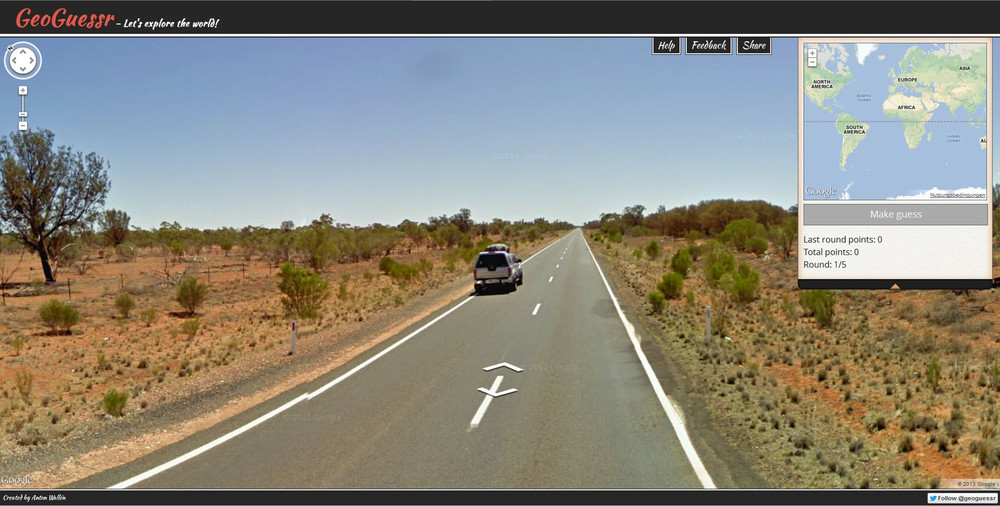
Two of my least favourite destinations are Brazil and the remote inland highways in Australia. Brazil is another great big country and it has the added disadvantage of having lots of towns, in lots of different states, that all have the same name. Sometimes, I just have to rely on guesswork.
The remote highways in Australia — something like this
are time-consuming because there's nothing to see except regular signs warning you to stay awake or offering an indentation in the road where you can pull over and take a nap. It must be a boring drive in person although at least then you'd know where you are and where you're going. It's boring when you're doing it virtually and you don't have that advantage.
Sometimes though, oftener than not, you find yourself in a place with no signs, no landmarks, no hints at all as to where you might be. But it's so nice there, you're happy just to mosey along and look at the scenery and take pleasure in the occasional flock of sheep.


On the one hand, I see the people saying, “I want my Canada back,” or, “I miss the country we used to be,” or variations on that sentiment.
In the same breath, there are references to what we did in 1938, when a ship carrying German Jews was turned back and its passengers had to return to Germany. There are also references to unwelcome immigrants over the years: Irish Catholic (micks), Italian (wops and dagos), Polish (polacks). There are, of course, numerous references to the First Nations.
We can’t have it both ways: either we used to have this nice country that accepted all cultures and religions equally or we have a sketchy history as quite an intolerant nation.
Which is it?
I grew up in northern New Brunswick. There was nary a Muslim in sight but there were the French and the Indians (sic) and to say they were second-class citizens is an understatement.
We had neighbours who were French. Their kids were smart in school and their house and yard were clean and tidy but in the neighbourhood, they were considered to be some kind of unusual French exception. We were still warned to stay away from the French we didn’t know. Head lice, or worse.
Bad feeling still exists. I have French friends who, if they weren’t going to visit family, would never set foot in New Brunswick.
I was scared of the Indians when I was a little girl. Most of the kids I knew were. Our family used to go for a Sunday drive and we’d often go through Burnt Church, an Indian reserve and one of the most beautiful regions on the Miramichi Bay. I just held my breath until we got through there safely.
In Nova Scotia, the history of the oldest indigenous black community in Canada is well-known: black loyalists who came after the American Revolution and were located to rocky lands where nothing could grow; blacks who came after the Civil War and after slaves were freed but who continued to be held in slavery in Nova Scotia; a tight-knit black community, Africville, who saw their homes bull-dozed in the spirit of urban renewal and integration but which led, in fact, to further isolation and alienation. African Nova Scotians continue to live, generations later, in a racially divided and racially-hostile society.
These examples are just in my little corner of Atlantic Canada. There are examples all over the country of the dominant cultural group making life less-than-comfortable for each generation’s designated “Other.”
Canada’s record of intolerance is not as bad as many countries and it may be among the better ones. The wistful longing to go back to when things were better, however, is just sentimental idealistic reminiscing.
We have to stop looking at the past through rose-coloured glasses and try looking ahead to the Canada we really want to be in the future. That has to start in the present.


I had watched five seasons of The Good Wife – American lawyers – and three seasons of Silk – English barristers – and I thought I needed a little break from the law.
I have begun to watch Father Brown, a series about G.K. Chesterson’s affable murder-solving priest. I remember Father Brown well from my earlier reading of the short stories. In the murder-solving genre, he’s a bit like Agatha Christie’s Miss Marple – an unlikely detective.
It’s just what I was looking for. The stories and the characters are gentle; there are murders but they’re genteel and the murderers are usually not evil and they often come to an accidental end before the Inspector can get his hands on them.
That’s a relief because the stories this time around are set in the early 1950s – in the aftermath of the war – and the death penalty was still in effect in Great Britain. Much better for our murderer to stumble on to the track in front of a moving train than sent off to be hanged.
Part of my enjoyment of the series is the beauty of the village and surrounding countryside where Father Brown tends his flock. At one point, I said to myself, I think I’ve been there!
I looked it up and sure enough, the series is filmed in different villages in the Cotswolds. Some of those villages were on one of the tours we took with The English Bus. As always with the tour, our guide – Colin, in this case – had much information and many stories about these beautiful villages and as we had in other places, we parked the bus and he led a walking tour to make sure we got the maximum enjoyment.
Here are some photos of our stop – two different stops, in fact. As always, remember to click on the photos to enlarge them.


William and I agreed that we could live in one of these houses (below) – if they had good Internet. (A standard requirement.)


 Fred Cogswell