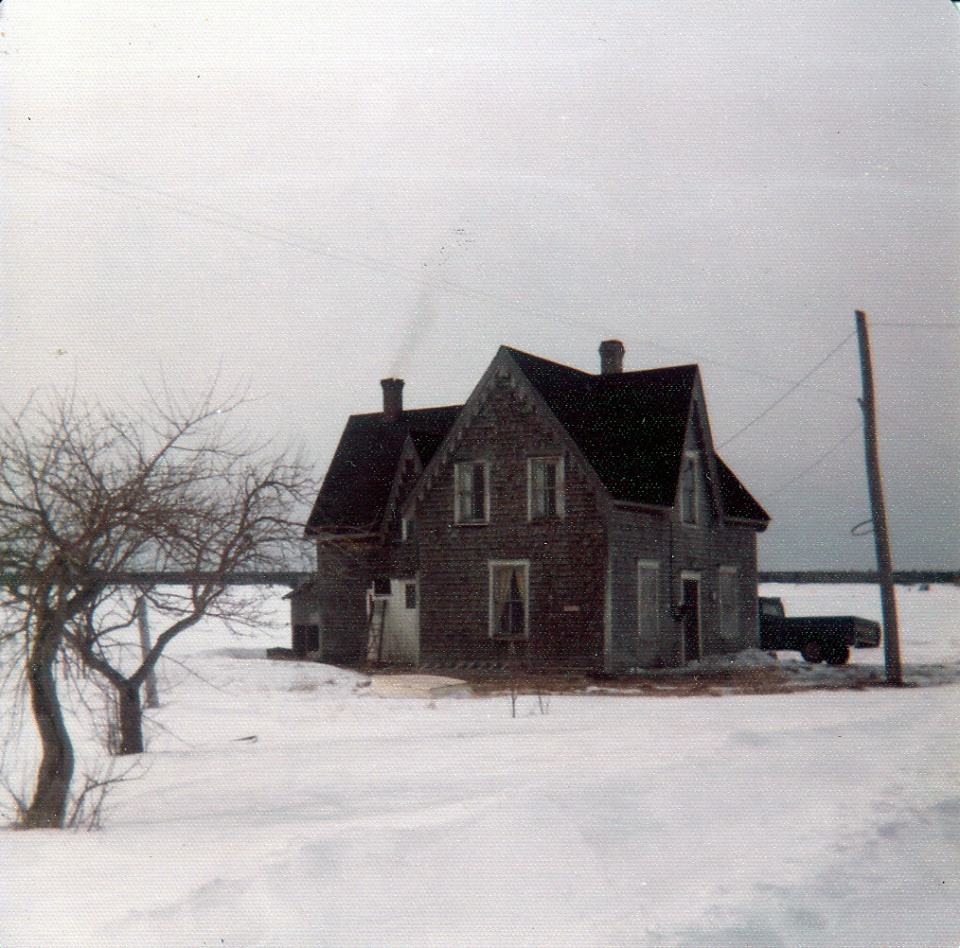
The house was on the shore, about 100 feet from the water, right where the Black River flows into the Miramichi.
It was a pretty house, weathered grey with sharply pointed gables and gingerbread trim. It looked a little worse for the wear. From a certain angle, it looked as if it were leaning back on its haunches; it had been built many years ago, with no foundation, and was "settling", especially toward the back, where the kitchen was. From the front, it looked as if it were hunching its shoulders against the northeast winds that swept around the point, blowing in from the Miramichi Bay.
It was a cold old house.
____________________________________________________________________________________________________________________________________________
February 17, 1976
I forgot to push the rolled-up blanket against the door before I went to bed so there was snow on the kitchen floor this morning. The wind battered the house all night. It's some cold. The glass of water I took to bed with me was frozen when I got up — frozen solid, not just a little skim of ice like sometimes.
The water in the kettle on the stove was frozen too. I got the fire going and waited for the water to melt so I could prime the pump — at least I remembered to drain the pump last night.
After I got the pump working, I filled the big copper boiler on top of the stove to get some hot water. It was wash day and I wanted to get an early start to get the clothes hung outside while there was still some daylight. I had a few dishes to do so I started on them first. The dishwashing detergent wasn't frozen but it had turned into a gel so stiff, it was almost solid. I had to use a knife to get some out of the bottle. I suppose I'll have to start keeping it in the fridge.
The fridge is huge. I saw it advertised in the newspaper and a deal was pretty much made over the phone. I've never had a very good grasp of the size of an object that's described in cubic feet. Anyway, I'm glad now. I keep many things in the fridge. It keeps them from freezing: things like canned goods and ketchup; oils and vinegars; potatoes, pickles and peanut butter — not to mention shampoo and conditioners, moisturizers, makeup and lotions. I think I could — as it used to be expressed — sell refrigerators to Eskimos. They could use them the same way I do.
I almost froze my fingers getting my big washtubs in from the shed. My hands were a little damp and when I reached up to lift the first tub off the hook where it hangs, my fingers stuck to the surface. I peeled them off; no permanent damage but I went and put my gloves on before I dragged the tubs in.
The two tubs sit side by side in the middle of the kitchen floor, one filled with hot soapy water, the other with less hot clear water for rinsing. The steam rises into the still-cold air of the kitchen like you see from those hot springs in Iceland. I sit on a cushion. I have a washboard for scrubbing and a hand-operated wringer that clamps on the side of the tub for wringing. A little shelf at the bottom of the wringer moves back and forth to keep the soapy water draining into the soapy tub and the clear water back into the clear tub. It's very efficient.
I put the newly wrung-out clothes and towels and sheets into a wicker basket on the floor beside me but before I got outside to the clothesline, the bottom layer had already started to freeze up. I put a few layers of newspaper and a folded blanket under the basket until I was ready to go out.
God, it was cold out there. I was already wearing long underwear, heavy pants, wool socks and a couple of sweaters and I added boots, scarves, jacket, mitts and a wool hat plus earmuffs. The wind was still blowing and if the clothes weren't frozen in the basket, they were most certainly frozen by the time I got the clothespin fastened onto the line. It's not that easy to do, wearing gloves and mitts and still having numb fingers. Why do I do it? Well, they'd freeze if I hung them in the house anyway and they dry a little faster outside, especially in that wind.
After the clothes were hung and as long as I was dressed for outdoors, I decided to fill the woodbox and take a trip to the outdoor facility to empty my little private indoor commode. It was frozen too.
I made some bread this afternoon. I had lots of potato cooking water, bottles and bottles of it — in the fridge, of course — and a bag of stone-ground whole wheat flour my sister had given me for Christmas. It has taken me quite a while to find the best way to raise my dough in that cold old kitchen. I tried placing the bowl in the warming oven of the wood stove but it was too warm. It rose too fast and the texture wasn't good. Placing it on the outer edge of the open oven door caused an uneven rise.
I finally worked out a system that involves hot towels, newspapers for insulation, and an enclosed space that holds some heat where I set my big bowl — a medium-sized cardboard box works fine. (I'm quite inventive. I'm the same person who used to bake beautiful loaves of bread in a fireplace that I built on the shore out of flat stones and mud with a refrigerator shelf from the dump as the baking rack.)
The rest of the day was uneventful. I brought the clothes in and stood them up around the kitchen until they thawed and fell over. They really do smell good. I read a lot, with my chair pulled close to the stove and my feet on the open oven door. I've drained the pump and I'm ready for bed now. My head got really cold in bed last night. I've put a large thick towel at the bedside so I can wrap it around my head tonight, if necessary. The stories I tell about living in the cold old house on the shore are not about poverty or hardship. They're credentials. I tell them because it's fun to tell them. I tell them so I don't feel I have to explain why I love my washing machine.
But I tell them carefully and never with a suggestion of deprivation. Every day I lived in the old house, I thought of the woman who had lived there first, whose husband had built the house in the early part of the century. She had eleven children, most of them born in those very rooms. She had no electricity, no car to take her to town for shopping, no fridge to keep her food from freezing. And her water pump, unlike mine which was conveniently located in the kitchen, was outdoors.
There was another woman I used to think of too, while I was living in that cold old house. She lived in Chatham, where I grew up, and I met her only once.
It was 1950. I was six years old, a sweet little girl with long hair curled into ringlets by my mother every morning, dressed carefully in tiny pleated skirts and crisp white blouses, sent to school with bookbag and accessories — a pencil case, a plastic ruler with a hole in the middle, a soft pink eraser, fresh notebooks, everything I needed. I went to The White School, an old wooden building that must have had another name in the beginning but was never known by another name in my time. It seemed very big to me; today, when I drive by the lot where it used to stand, I realize that it didn't take up much space. The students who went there were mostly working class; a few were middle class; some were very poor.
One day in winter, all of us in grade one, having struggled into our winter duds, were standing in line in the ante-room waiting for the teacher to come around and tie our scarves at the back of our necks so they'd be ready to pull up over mouth and nose for the cold walk home. As she approached me, I saw with dread that she was carrying a small sheaf of papers.
"I want you to take Eddie's lessons home to him," she said. "He was sick today."
My little heart sank. I was scared of Eddie anyway and I had heard all the lurid White School tales about the house where he lived. I didn't understand some of it but I knew what a bootlegger was. This was a grade one nightmare.
I lagged behind the others on the way home. I tried to think of some way of getting out of it. Finally — but much too soon — I turned down the street where Eddie and his family lived, in a ramshackle frame house behind an abandoned building. I picked my way through the rubble in the snowy yard — old car parts, an overturned wheelbarrow, a wagon with no wheels. Before I knocked, the door opened. A woman holding a baby was standing there.
"Who are you? Who sent you 'ere?" she said.
"I brought Eddie's lessons from school."
"Come into the 'ouse."
Oh no oh no. This was not part of the deal. The room she led me into was more like a shed: it had bare board floors, a few old sticks of furniture, an unmade bed in the corner. It was cold. There was no sign of Eddie or any of the older children or the bootlegger but there were small children, a few of them — toddlers and babies.
"What's your name?" she said. I told her.
"I know where you live. A new 'ouse."
It was a new house; it was owned by the power commission where my father worked. It was an ugly house and my mother didn't like it. But it had a furnace and rugs and matching furniture and curtains. To Eddie's mother, it must have seemed like living in a palace.
My childhood experience had not prepared me for her house. How could I have fit that cold hovel, those ragged children, that unkempt woman into my ordered little life where we collected money in Mission Band to buy food for hungry little heathen children in India; where we made little drawstring bags out of facecloths and filled them with soap and toothpaste and toothbrushes and combs and maybe a barrette for deprived children in Africa?
How could it be that there were little children in Chatham living like this? Did they have enough to eat? Did they ever have roast beef on Sunday? Did they have any toys or storybooks? Did anyone ever take them to the beach? Did they have aunties and uncles who visited at Christmas? Was there even a stove in this place?
These specific questions came to me years later; at the time, I asked no questions at all. I don't know why except little children often feel shame and embarrassment when faced with complex situations that are uncomfortable.
I never saw Eddie's mother again. I think they moved away shortly after my visit. I never told anyone I'd been there.
There was something else I never told anyone. The day I went to Eddie's was the third time the teacher had asked me to take his lessons to his house. The first time, I tore the pages into little pieces and buried them under a rock in a swampy ditch on the way home. The second time, I put them at the bottom of the box where I kept my supplies for playing school. No one ever found them.


Wednesday, January 11, 2023
Two Miramichi winters

Monday, November 8, 2021
'As good as any, better than most'
February is Black History Month; March is Women's History Month. Either one is an appropriate time to look back at the life of Dr. Carrie Best.
In the history of Nova Scotia — home of the largest indigenous Black community in Canada — Dr. Best was well-known and admired for her many years of work on behalf of her people. She died in 2001 but not before she had made her mark and helped to dispel some of the egregious racism that existed throughout her life.
She was born in New Glasgow in 1903. In 1946, she founded The Clarion, the first newspaper for Blacks in Nova Scotia. She wrote for newspapers and magazines and was a weekly columnist with The Pictou Advocate. She was the author of an autobiography, That Lonesome Road (which is also a social history of Nova Scotian Blacks.)
She was well-known across the country as an equal rights activist and was a founding member of the Kay Livingstone Visible Minority Women of Nova Scotia, an organization which works with women and young people to promote a sense of identity and pride of race, integrity and self-discipline “and to lift others, as we ourselves climb toward dignity and self-respect.”
Her last doctorate was awarded in 1992 by the University of King's College in Halifax. In 1970, she was awarded the Lloyd MacInnis Memorial Award for her work in social justice. In 1973, she received the first annual award of the National Black Coalition of Canada. In 1974, she was appointed to the Order of Canada. In 1975, she was granted the degree Doctor of Laws by St. Francis Xavier University.
In December of 1991, she received an award for outstanding contributions to human rights on the anniversary of the day the United Nations ratified the Declaration of Human Rights.
I interviewed her a few years before her death at her home in New Glasgow. She scoffed at my tape recorder and refused to let me turn it on, telling me she didn't want to talk into "that thing." I returned to the time-honoured tradition of taking notes. Her words are in italics. My occasional comments are not.
The 'religious hobo'
Dr. Best is in perpetual motion, rummaging in her well-packed briefcase for a pertinent document, punctuating her remarks with a gentle jab to her interviewer's shoulder or a soothing pat to the knee. Her energy and vitality are infectious. She often speaks with tongue in cheek.
* * *
I was invited to give the convocation address to the Atlantic School of Theology. I nearly dropped dead when they asked me! They can't mean me, I said. Do they know I don't go to church? Well, I slept on it. I do live close to God — I'm a born-again Christian — but I consider Christianity and “churchianity” two different things.
In the end, I accepted. I described my religious background to them and told them I was a “religious hobo.” When I was born, my parents were Salvationists and that's how I was registered at birth. When I was a young child, they left the Army because the first “black church” had been established in Pictou County. That was Baptist.
When I grew up, I had the bad taste to marry an Anglican but he was good enough to go to the Baptist church with me. After a time though, he missed the Anglican way of worshipping so ... he had accommodated me and I thought it was my turn to accommodate him so I went to the Anglican Church with him. But I missed the Baptists. The Baptists clap and laugh and sing and really know how to praise the Lord. So I went back to the Baptists. You can see I'm a religious hobo.
As I got older, I met so many wonderful people of all religions. I began to accept people for what they are — colour and creed don't matter. I believe that all roads that lead to God are good.
The root of my faith is Mother Earth. I think of all the little creeds as just different ways of interpreting God.
So that's what I told the graduates of the Atlantic School of Theology! * * *
That Lonesome Road is dedicated to her mother. On the dedication page, she wrote, “Society Said: You are an inferior being,/born to be a hewer of wood/ and a drawer of water/ because you are Black.... My Mother Said: You are a person, separate/ and apart from all other/ persons on earth. The pathway/to your destiny is hidden.../ you alone must find it./ ...And then she said.../ Take the first turn right,/ and go straight ahead...”
* * *
It's very painful to talk about some of the practices of the past. When I was growing up in New Glasgow, you couldn't eat in a restaurant. You couldn't get your hair cut. I went to jail. My son and I were at the movies; we sat downstairs, we went to the movies three times a week and we'd sat in the same seats for years. Then one day, the usher came to me and said, “You can't sit here. You have to go into the balcony.” I refused. They called the police; they had to drag me out of there. I was in jail for an hour. I was charged with causing a disturbance.
But at all times of my life, I've been a happy person. When I was young, I think we might have been broke but we were never poor. I was personally just as happy no matter what we had. My personal happiness had nothing to do with racial discrimination.
I confront bigotry face on. If I hear — and this has happened — that someone has called me “n****r,” I go right to that person. I look him right in the eye and I say, “did you call me 'n****r'? Now I've heard you did and all I want from you is to tell me if it's true. If you say it isn't, I'll believe you. We'll go together to the person who told me and you will tell him it isn't true.” You could always tell if it was true or not.
I'm not a n****r. I'm as good as anyone and better than most. I love everyone who's worthy of my love — but I won't sit back and take that kind of bigotry. * * *
Her memory seems unlimited. She quotes long stanzas of poetry, long passages from books, most of which were learned many years ago. She considers poetry to be part of her spiritual nature and part of her search for identity.
“The long hours spent in reading poetry,” she wrote in That Lonesome Road, “and the hundreds of poems memorized during my early childhood, my learning years, my yearning years and even now in later life, are fragrant memories of my journey in Search of an Identity. The irresistible habit of committing poems to memory still persists, and like deposits in a savings account, can be drawn out at will. The fund is never exhausted, for the interest grows both on deposit and withdrawal and is compounded daily.
“Black history was virtually non-existent in Nova Scotia during my learning years ... I remember when I received my cherished volume of the Poetry of Paul Lawrence Dunbar. I was ten years old ... I found to my utter astonishment and delight that I could read the Dunbar poems which were written in the Negro dialect as easily as those he had written in classic English. These gave me my first sense of Black Identity.”
* * *
Things have changed — but not enough. The white race has got to start learning from those they feel superior to. The Blacks have to take pride in who they are. When Frederick Douglass was a young slave, the white mistress said, “He's a bright boy. I'd like to teach him to read.” The slave master said, “When you educate a Negro, you unsuit him for a slave.”
Education is very important — more important than ever. We have to start teaching our children ourselves — in “kitchen schools.” We have to get funding from Black churches, Black organizations, and take the time to teach the children where they come from, how far they can go.
Being old now is not a disadvantage to me in all my projects. It's a blessing. God gave me this extra time to accomplish whatever I can, to meet wonderful people of all races. I'm so thankful.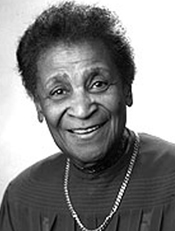
Friday, October 1, 2021
Rita Joe: Creating a beautiful image of her people

Rita Joe died in 2007. In 1994, I spent a day with her in her home and shop, chatting, snacking, crafting. She crafted – she made beautiful earrings and other jewellwey – and I watched. She gave me a pair of earrings to take with me when I left.
Rita Joe is the acclaimed Mi'kmaq poet. She was born in Whycocomagh and now lives in Eskasoni, the largest reserve in Nova Scotia. She is a mother, a grandmother, a weaver of baskets. She sells her crafts and those of her family and community in her Eskasoni shop. What follows are her own words.
...............................................................
I describe myself as Native – Mi'kmaq. I'm 62 years old now. When I started writing, I was in my 30s, and I saw a need: that was to create a beautiful image of my people. When I was a little girl, I was called a little savage, a cannibal. I didn't know what cannibal meant – all these derogatory things I heard when I was a little girl.
When my children used to bring their books home and see something bad like that, they'd point it out to me. “Look Mum, look what it says here,” and I would read it.
And I would hear myself say, we were not the writers of our own history. Then I would say to myself, why aren't any books written about the beautiful part of our culture? So it dawned on me that there has to be somebody to document the beautiful part. So I began to write.
I am the Indian
and the burden lies
just with me.
I have spoken across the nation and when I read that little three-line poem, there is heavy discussion. They're trying to find out, what is the burden, what is the burden that Rita Joe is talking about? I tell them: the burden I'm carrying came from you, the European. You have made me carry my burden because you're the ones who documented our lives and it was not the truth.
In any culture, any culture on this earth, when you look for the good, you'll find the good. That's what I look for so I can present it to the people who look down on us. I have been doing it so long that my own perception of my own culture – to me, it is beautiful. Everything about my life, since I was a little girl and what I have seen since is beautiful.
When I was a little girl – my mother died when I was five – I was put in a succession of foster homes, all over Nova Scotia. I can't tell you how many different foster homes I was in but I had a lot of mothers, I had a lot of dads. I came back to live with my own father just before he died. I was nine and I lived with him for a year. I used to see him open a book of hieroglyphics. That's why I say in one of my books, the written part of our life is for us to read which you did not recognize – same with Egyptian writing, that was not recognized. I saw my dad open a book a lot of times and read and I saw him explain these symbols and I know there was a written part of our life – that's why I said in a poem “that the world chooses to deny.”
I was mostly in native homes, not that many non-native homes, and they were as poor as I was. There were times when I didn't have enough to eat.
All these homes, Mi'kmaq was spoken. All my life, I've spoken Mi'kmaq. When my dad died I was 10. I was placed in a home with this woman and she told me, “Go home and pick up your clothes – don't bring them all because I'll make dresses for you.” I loved her, she was a good person. I went home and got my little box. Right at the time I was putting my clothes together, somebody came up the stairs. A woman took me by the hand and told me to come with her.
When you're 10 years old, you listen to older people – especially if your dad is dead and there's no one advising you. So this woman took me by the hand and led me away and put me on the train. They took me to a non-native community and I went to school there. I was 11 when I went to school there and of course, they made fun – they were all non-natives. They jeered and I made a vow at that time that I would get higher learning. I would teach these people that I'm just as good as they are.
I was 12 years old when I put myself into the Shubenacadie Residential School. It was that determination to learn – to learn to cook, to sew and all these things.
When I arrived there, I admired the place. It was so beautiful – the shining floors, the pictures on the walls, the beautiful building. The priest at the time when I was there, we became good friends because he was also from where I just came from – Cumberland County. He would never remember my name, Rita, but he would call me Cumberland County. He was a nice gentle old man, he was so kind.
I had some bad experiences in school but the way I look at life, I forget about the bad things that happened and I look for the good. I always look for the good. I consider it being Christian to be forgiving, not to carry injustices on your shoulder all your life.
I read a book written by an anthropologist about a writer who lived 300 years ago and he wrote this: they have no religion; they have no art. He was observing Native people, and I just threw this book down. The gall of this person to say that we had no religion. We had a beautiful spiritual part of our lives that they did not know.
Me, I never accepted it. When I was told by the nuns, “your religion is no good,” I always knew in my mind sure, it's good, it might even be better than yours.
There's an oral tradition with my people. We're always talking amongst ourselves. My husband's family was from Newfoundland. At the time when my husband-to-be and I met in Boston, he asked me to marry him the second week after we met. At the time when he proposed to me, he said we're not related, are we? Native people are always concerned about that.
The sweat lodge is a very religious experience. Part of the tradition is traditional food – deer meat, or meat of other animals we have killed – moose and deer and salmon, not something that we've bought from the supermarket. Or something that was donated from the people in the community – eels maybe.
The two sweats that I have taken part in, the first one was here in Eskasoni. Everything that I write about, I try to take part in it. I did not know when I went in there what one experiences. So it was very frightening at times what I experienced. The learning I got from the sweat lodge did not come from the live people who were in there with me – there were 13 of us – the teaching I gained from that sweat lodge came from the spirits that were there.
It's very hot, even hotter than a sauna. The medicine woman who was sitting next to me kept touching me and saying are you alright Rita, do you want to leave? I said no, I wanted to stay, and I stayed for two hours and 40 minutes. I stayed in one in Restigouche for five hours. They were all women there. The all-woman sweats are more powerful than the men's. Women have more spiritual power than men. Men have spiritual power too but women have more. Everybody knows that – even the men recognize that.
One time, when I was in Vancouver, I took the baskets that I make with me. Some of them are made from sweet grass. They scolded me for them. You're not supposed to use sweet grass in basket-making, they said. It's a sacred grass and it's supposed to be used only for sacred purposes. The way I explained it was when I make my baskets, I make them for people to enjoy the basket. Because whoever purchases the basket, they do it because they love the little basket and when they're sweet grass, people want them, right away. So I was explaining to the Natives up there, when I use sweet grass in my baskets, it makes people feel good and I don't think our Creator is going to get angry with us for making other people feel good.
Sometimes, I weave sweet grass into braids and I tie them on each end and when I'm doing it, I'm thinking about love.
Sunday, March 7, 2021
How can I ignore, the boy. . .
(This piece comes from my archives. It was published on Saturday, July 14, 2012.)
It used to be, if you wanted to be a writer, the prime advice you were given was, "read." You were advised to read books, magazines, newspapers – just keep reading. The purpose of all this reading was to help you recognize words, sentences, paragraphs – not to mention style and rhythm.
It's still good advice although it comes today with a caveat.
It used to be that you would very occasionally see a typographical error in a newspaper story. You would almost never see a typo in a magazine article and if you saw one in a book. . . well, that was a topic of conversation for the dinner table. It was almost unheard of.
Things have changed as most organizations have decided to do without proof-readers and copy editors and as we've moved into the era of the spell-checker. Everyone knows the perils involved in depending on the spell-check. (Don't get me started on the use of "lead" instead of "led." Stop doing that, you people!)
So spell-check doesn't solve the problems around the use of the wrong word – even if it's spelled right – and that's where wide reading comes in: word and phrase recognition to the rescue where "sounding it out" fails.
While you're reading though, watch out for these hazards, all of which I've come across recently – some of them, more than once. Clearly, these are the results of hearing, not reading:
• tow the line. This is so common, I see it several times a week. In case you don't know the problem, the proper expression is toe the line.
• can't bare the pain but, on the other hand, bear your soul.
• by in large. I'm trying to think of something to say about this and nothing is coming to me. Sorry.
• I suppose I could have said – as some people would – I'm in the throws of woe, just reporting this.
• Or I could tell you I've been pouring over catalogues (pouring what? whiskey? wine? lemonade?), to see if, without further adieu, I could buy something to cheer myself up. Just last week, I came across a mis-use that's R-rated so cover the children's eyes. A blogger whose work I often look at was writing about her favourite love songs. She linked to one song on YouTube and wrote, "I can't listen to this song without balling." Oops. Too much information?
My final strange little error is where my title originates. It's from the website of someone whose work I enjoy and respect. She's a good writer, intelligent, writes bravely about politics, religion, sexuality, parenting – among other subjects.
She and her family have recently moved to a different city and she's been writing about how they're all adapting. Her oldest child has a new playmate, the boy next store. Excuse me? I smiled because I know what it's like to hear a sound in your head and have it come of your finger-tips as right sound, wrong word. The boy next store. Pretty funny.
I was wrong about it being a one-off understandable mistake though. She referred to the new playmate several times – maybe five times – and every time, she referred to him as the "boy next store."
It seems impossible to me that someone who reads widely has never seen the expression, "boy next door." But she's given me a nice conclusion to my reflection on words that must be seen as well as heard.

Tuesday, December 10, 2019
Back in time: December 1989
This column was published in The Daily News in Halifax 30 years ago today, December 10, 1989. Four days earlier, 14 young women at École Polytechnique in Montreal had been separated from their male classmates and brutally murdered. Their murderer accused them of being feminists and said that feminists had ruined his life.
There were already people who were insisting that this act was an aberration, that the killer was a one-of-a-kind madman. Feminists fought that view long and hard and this year — 30 years later — it's finally been acknowledged that the massacre was motivated by misogyny and was an extreme instance of violence against women.
Meanwhile, a woman or girl is killed every three days in Canada, with a total of 118 killed by violence in 2019, according to the latest report from the Canadian Femicide Observatory for Justice and Accountability.
The only changes I've made in the column from 30 years ago are a couple of short additions in square brackets.
December 10, 1989
On Thursday morning, distinguished lawyer and former MP George Cooper made a little joke on CBC Radio’s Information Morning. He was discussing the recent NDP leadership convention with host Don Connolly and panel mates Dale Godsoe and Ray Larkin when he decided to use a colourful comparison to express his opinion about some aspect of the race.
It’s a good news/bad news sort of situation, he said, like that old joke about your mother-in-law driving over a cliff — trouble is, she was in your brand new Cadillac at the time. I believe I detected some laughter from the others and I’d be interested to know whether the CBC switchboard lit up with outraged callers, the way it does when someone says a rude word on the air. Somehow I doubt it.
In my household, we sat in stunned disbelief, hearing a joke which would be in poor taste at the best of times but was absolutely scandalous being told and snickered at the morning after the murder of 14 women at the University of Montreal.
It wasn’t the only joke being told that day. Francine Pelletier, a Montreal feminist who was interviewed extensively on the TV coverage of the murders, said that men in the corridors at Radio-Canada were treating the massacre in a most light-hearted way, one of them remarking, “I’ve often wanted to do that myself.”
At around the same time, a young friend of mine was walking into Tim Horton’s to buy some doughnuts. There were two men in front of her carrying a newspaper with a screaming headline about the murdered women and one of the men said something along the lines of, “way to go, buddy.”
Her friends asked her how she handled this awful moment; most of them felt, bravely, that they wished they’d been there. In retrospect, we can all come up with the enviable line, the cutting quip, the perfect putdown.
She said nothing, of course. There are few women — including me — who could respond to those men. Such verbal violence is part of what renders women powerless, unable to act, not so much from fear as from emptiness, from the debilitation that results from crying out for so long and not being heard.
I’ve been told so often — all feminists have — to lighten up, to learn to take a joke. They don’t really mean anything by it, you know. This week, finally, I’ve been told by men — among others, by Peter Gzowski [the late host of CBC Radio's Morningside] and his panel on the radio, by Tom Regan [a former columnist with The Daily News] on the phone, by my husband at home — that it is time for them to do something about their violent brothers.
They know now that they must begin listening to women and they must refuse — loudly — to listen to the dehumanizing “jokes” that so many of them allow to slip by. They must disdain the views of those who keep saying that the carnage in Montreal was an isolated act carried out by a madman.
They must examine and be willing to change their political, economic and judicial systems, all of which conspire to keep women in positions of dependence. They must observe their sons — their vocabularies, the games they play, the way they’re learning to deal with anger, the things they say about little girls. They must stop undermining the mothers and, once and for all, lay to rest that age-old excuse that “boys will be boys.”
They must not simply be available to provide protection; they must work actively to create a safer world, where their sisters and daughters and mothers can live with the same sense of security that brothers, sons and fathers take for granted. They must recognize and acknowledge that the 14 women in Montreal are only the most recent to die at the hands of a man, that in 1987, almost 70 per cent of women murdered in our country were murdered by the men they lived with.
One of the buttons we brought back from the Winnipeg NDP convention — where I saw the joy and exhilaration on the faces of the women who had worked to elect Audrey McLaughlin as their leader — bears the slogan “Men of quality are not threatened by women seeking equality.” The words seem almost horrible in their irony this week but the message remains true.
And so it’s time to take another step forward, to convince men that violence against women is the fault of men and — to resurrect an old phrase — if they’re not part of the solution, they’re part of the problem.
Friday, July 5, 2019
The two lost years of Pandora
(Pandora was a Halifax feminist publication that was taken to the Human Rights Commission in the early 1990s for discriminating against a man. This is an account I wrote after the hearing for the The Canadian Forum.)
In March of 1992, the Nova Scotia Human Rights Commission announced a decision in favour of Pandora, a Halifax feminist publication, which had refused to publish a letter written by a man.
"I am satisfied on the evidence before me," wrote the adjudicator, lawyer David Miller, "that women as a group have been and are disadvantaged and unequal in our society by reason of sex... It follows, accordingly, that a disadvantaged group may undertake a programme or activity which has as its object the amelioration of conditions of disadvantaged individuals or classes of individuals including those discriminated against on the basis of sex even if that results in distinctions being made with respect to the advantaged group...
"I am also satisfied that Pandora is an activity which has as its object the amelioration of conditions of disadvantage to women based on sex. I am also satisfied that Pandora's policy of maintaining Pandora as a single sex newspaper is reasonable for the purpose of ameliorating disadvantage."
In the mainstream media, paternalistic pundits all sang the same tune: right decision, wrong reason. All agreed that Pandora has a right to set her own editorial policy – although, they added, all publications owe it to their readers to publish a wide spectrum of opinion. Many of them were unable to comprehend the view that Pandora does publish a wide spectrum of opinion – all written by women.
But this was not an issue of freedom of the press. Indeed, throughout the Human Rights Commission hearing, Pandora made it plain that the only issue was the need for women-only spaces as one way of working toward equality.
The beginning
This story begins in the spring of 1990 when Pandora ran an article about child custody. Halifax resident, Gene Keyes, phoned the newspaper to ask if he could write a letter in response. He was turned down because of Pandora's clearly stated editorial policy: "...Pandora reserves the right to publish only letters that fall within the guideline of our editorial policy; letters must be written by women and be woman-positive; we do not accept material that is intolerant or oppressive."
Alas, Gene Keyes was no ordinary reader. During the '80s, he had been through a bitter custody battle, which he'd lost; he was a well-known fathers' rights activist. He defines himself – and the media were always satisfied to accept him according to his own definition – as a member of a disadvantaged group: divorced fathers who are discriminated against by the justice system. (The facts don't bear him out. In our country, most child custody is settled amicably between two parents. In disputed cases, fathers gain custody in over 50 per cent of the cases.)
In June of 1990, Gene Keyes filed a formal complaint of sex discrimination with the Nova Scotia Human Rights Commission against Pandora Publishing. Although there was an attempt at conciliation, no agreement could be reached. Incredibly, the Commission decided to proceed with the case.
Pandora
Pandora cannot accurately be called a "newspaper" although it does, indeed, publish some news. In general though, it's a publication by, for and about women which asks its contributors to share their experiences and their realities with their sisters; it makes no claims to "objectivity" as the mainstream media do. It asks its women readers to become part of the publication – to write to Pandora as if they were writing to a friend.
And indeed, there is a feeling of sisterhood in Pandora, a sense that the paper is a shared activity and that the struggles described are collective, not individual. If a single mother writes about living in welfare poverty, she doesn't expect to hear someone hissing, "get a job!" If a teenager writes about incest or a grandmother writes about fear on the streets, they feel the security of a community which will understand and help.
It wasn't like that at The Hearing.
The Hearing
The Human Rights Commission hearing against Pandora was held on five cold days in January of 1992. The adjudicator, David Miller, was male. The Commission's lawyer, Randall Duplak, was male. Gene Keyes, representing himself, was male. And the system was, most certainly and unmistakeably, male.
It was an adversarial situation of cross-examinations and rebuttals. There was always the feeling that if a witness slipped up and said the wrong thing, fingers would be pointed, heads would roll.
There was something surreal about seeing this little feminist newspaper forced onto the defensive by a hierarchal, authoritarian system that she had no part in making.
To make her case that women are a disadvantaged group in our society, Anne Derrick, Pandora's lawyer, called 18 witnesses including a feminist historian, sociologists, experts on media, and past and present members of the Pandora collective. All but one of the witnesses were women. (The Pandora women appeared under pseudonyms; when the news of the hearing hit the mainstream media, death threats began showing up on their answering machine.)
After the hearing – and before the decision – some of the women wrote in Pandora how they felt about what had happened:
"...My special relationship with Pandora as a small women's-only community was torn as I watched and experienced male definitions and bureaucracy invade our thoughts, opinions, experiences and policies. We were no longer operating on our own ground, but became vulnerable to the rules of those who were defining the agenda of the inquiry. I wished I could just jump up and scream out, `this is crazy and we're not going to take it any more...'" one wrote.
Another wrote: "...Because women have been, and are, deliberately excluded from the development of the texts and practices of the underpinnings of this society (law, medicine, religion, business etc.), we have been silenced and oppressed. Sheltered spaces such as Pandora give us a safe place to birth our own agenda, teach it, nurture its growth until we someday send it forth a mature adult who will stand beside the texts and practices to have an equal say in society..."
Still another wrote: "...We danced with the system, to their rules, in their ballroom. It was damned uncomfortable, frustrating and tiring, but we survived, elegantly..."
The aftermath
Anne Derrick, Pandora's lawyer, says this case never should have proceeded, but as it did, it becomes a very important case and decision.
"The Commission tries to downplay the importance of the case," she says, "but it is the first time in Canada such a decision has been reached. It has much broader implications than most people have considered; not only women but all other disadvantaged groups in society will be affected by it."
Derrick was not particularly surprised at the outcome. "I felt the choice of this adjudicator gave us the prospect of getting this decision. I felt he had the ability and the intellect to grasp the arguments."
Having said that, she's also not persuaded that the Commission learned anything from the hearing.
"The response we've had from the Commission about what happened after the hearing makes me say, `they still just don't get it.'"
The day after the Commission's decision was announced, Derrick and a coalition of Pandora's friends called a news conference to demand an apology for the language used by the Commission's lawyer in his final written argument. He called Pandora women and their expert witnesses "hysterical man-haters," "radical extremists," who presented arguments "beyond reason and sanity." He said the paper did not represent women but only lesbians. He noted that the witnesses for Pandora did not take their oaths on the Old or New Testaments, the Koran, or any other of the many holy scriptures provided, but were affirmed.
Women's groups and individuals rallied in defence of Pandora and her witnesses but the Human Rights Commission has been unwilling to deal with the inappropriate language used by their lawyer and considers the case closed.
Most people would agree that part of being oppressed means that you have been defined by someone else. For women, these definitions not our own, have been very dangerous, not to say life-threatening. Women have been told that sexual harassment is flattering, that rape is just good sex preceded by a struggle, that being battered is our own masochistic fault.
Pandora, still as wise but now much poorer, is back to providing a safe space for women to work on their own definitions; back to challenging those oppressive structures that are responsible for these two lost years.
And finally, Pandora is back to being by, for and about women – this time, with no arguments.
Sharon Fraser is a Halifax journalist. She testified on behalf of Pandora as an expert witness on media.


Sunday, May 26, 2019
A posthumous award for Ray's book, 2019
Ray's last book before his death, Through Sunlight and Shadows, won the 2019 New Brunswick Book Awards prize for fiction. It was presented at a New Brunswick Writers' Federation gala at the Moncton Press Club May 25.
I was very grateful to be there and to have the privilege of accepting the award as Ray's former spouse and as his literary executor. I spoke from notes and this is approximately what I said:
One of the great moments in Ray's life happened when he was a very young man living in Chatham, New Brunswick. He saw a poem by Alden Nowlan and it was the first time he realized that you didn't have to be British, or American, or dead, to be a writer. If he were here tonight, he would see so much more evidence of that early realization.
I know he would want to thank his publisher, Lesley Choyce at Pottersfield Press for making such a beautiful book. And he would thank his many friends who so willingly proof-read and critiqued and edited to make sure it was the best book it could be. He had become a lot mellower as he got older and actually allowed people to make suggestions and possible changes.
My husband, Dan, is here tonight. Dan and I were with Ray during his final hours and in the days leading up to his death, while he was still able to communicate, we could see that one of the things he was most concerned about was his literary legacy.
Because of that, I want to thank the archives at the UNB library and the archivists who worked with us for their careful and loving collection of his works.
The archivist who helped us clear out Ray's apartment was amazing. It was like watching someone panning for gold and pouncing regularly on what was obviously a nugget for her. Pure gold. Ray wrote always and everywhere. He left behind countless notebooks packed with writing that was almost illegible to anyone but him. A scrap of paper on his kitchen table might have been a grocery list or it might have been a list of synonyms — a search for the perfect word. Notes scribbled in the margin of a sports magazine left in his bathroom might be the perfect scrap of dialogue he was looking for.
Christine gathered and filed every one of them and when I was able to tell Ray about the process — he was already in palliative care — it seemed to bring him to a place of peace.
Ray's funeral was held in the church of his childhood and he's buried just a stone's throw from the house where he was born — the house and the church that figure so largely in this very book.
It seems a fitting ending — full circle, in fact, and I think he would see this as a perfect conclusion to this part of his story.
He left some unpublished work so there will be a sequel — I'm his literary executor so I can say that — but talk of that is best left for another day.
Thank you all, so much, for this wonderful honour. Dan didn't want to be obtrusive while I was speaking — which I think was very considerate — so he shot the pictures from his only possible angle.


Tuesday, March 19, 2019
Fire! Noise! Music! how much excitement can you take?
Today, March 19, is the feast day of St. Joseph. He's the patron saint of Canada and of many worthy causes but nowhere is he more revered and celebrated than in parts of Spain. In Valencia today, a days-long festival will come to an end with fireworks, parades, lots of music and finally, bonfires throughout the city as massive statues built for the occasion will be set ablaze.
This is the statue in Valencia's main square and it will be the last one to burn tonight. It will be sometime around or after midnight their time — sometime after eight here in Atlantic Canada. (They haven't set their clocks ahead.)
The festival is called las fallas, literally "the fires."
I was once in Valencia for las fallas. When I got out of bed on March 19, I thought I had awakened in hell. The cacophony was deafening. I looked out the window and the air was filled with smoke. People were crowded into the streets, laughing and singing with bands that were playing in most neighbourhoods. We went out and joined the ruckus and got swept along in an almost helpless state; it was impossible to fight against it. I noticed at a certain point that many people were wearing earplugs, an excellent idea although too late for us.
There were firecrackers going off everywhere but also day-time fireworks. You couldn't really see them but seeing them was not the point. You could definitely hear them. Bars and cafés and restaurants were open and doing a grand business selling mountains of paella and gallons of wine and beer.
We followed the crowd and saw lots of the crazy statues before they went up in flames. As so many of the festivals in Spain do, the symbols incorporate a lot of religion and politics and they're often viciously satirical. Trump shows up a lot this year.
Here he is in the company of Franco, Stalin and Hitler. We will probably hear the cheering from here as this one burns.
I'm going to watch the main statue burn on the webcam from the Plaza del Ayuntamiento (Town Hall Square). As I write this, they're already making the pre-burning preparations.
We survived it, being there in person, and I have to say it was very exciting even though in many ways, it was pretty scary.
Join me at the webcam though. I recommend it!
And tomorrow, the first day of Spring, the neighbourhoods will be back planning and drawing and collecting materials to get started on their statues for next year!


Monday, November 26, 2018
Finding the origins of Ray's spiritual growth
Ray Fraser 1941 — 2018: writer and poet, story teller and singer

A few days before he died — he was in palliative care at the Everett Chalmers Hospital just before a move to hospice care in downtown Fredericton — Ray told me that the doctor had been in and offered him the option of an assisted death. He asked me what I thought of that.
I told him it didn't matter what I thought. What mattered is what he thought.
"I don't think the Catholic Church thinks much of it," he said, with a wry smile.
I said it was a very complex issue and it often took the Catholic Church a couple of centuries to reach a fixed conclusion on this kind of thing. That amused him.
He dozed off then and it didn't come up again. I didn't want to bring it up because I didn't want to sound as if I were trying to influence his thinking or to push him into a decision he didn't want to make. Or an opinion he didn't want to have. I did, however, make a point of telling him that if he wanted to talk about it again, I didn't mind but I'd wait for him to bring it up. It never came up again. After his move to the hospice, it was no longer an option and that was okay because I think everything had been said that was going to be said.
After Ray's death, when I was back home at my own computer, I was going through past emails, looking for addresses, people to be contacted, dates of certain events. I came across an email from myself, written on March 2, 2016:
Did you read this? It’s quite an astonishing story and much of it is about Al Purdy. I’m still trying to get my head around it. The article I linked to was from Toronto Life and was written by John Hofsess. John was a right-to-life activist and before his own death (by assisted suicide), he had facilitated the deaths of eight people, including the poet Al Purdy.
I thought the story would interest Ray because we knew Al Purdy a bit back in the Montreal days and also because he liked Al Purdy's poetry. Ray had started a literary magazine (the infamously-named Intercourse) and he had well-known, high profile contributors — among them, Leonard Cohen, Elizabeth Brewster, Alden Nowlan, Irving Layton and yes, Al Purdy. Ray not only liked Al's poetry but he liked the tough-guy persona that Al affected.
We met him a couple of times at parties where he would usually be the centre of attention — except for the time when he and Margaret Atwood showed up at the same party. She had just won the Governor-General's Award for poetry and Al appeared to happily relinquish the centre-of-attention position to her — for that one time anyway.
Ray's response to my email and to the Hofsess article about assisted death held much more significance for me when I read it last week — a month after we'd talked about it in the hospital — than when I read it two years ago. He wrote:
Interesting. I think a body should do his time and leave when he's meant to, speaking for myself. Although if you turn into one of those brain dead vegetables in old folks homes it might be nice if someone shot you.
All the pain I've known so far has had a lesson in it. As the saying goes, "Pain is the touchstone of spiritual growth". You find things out that way you wouldn't any other. And none of it is needless. That's so far, and so far has gone on for quite a while. "So far" for Ray amounted to 77½ years.
In a subsequent note, perhaps having re-read the article, he said it struck him that "Hofsess is more an egoist than an altruist." And concluded, "Anyway, I think if you live right you'll probably die right."
I'm thankful that it ended easily for him but I know that "living right" doesn't always guarantee an easy death. Far from it.
The only guarantee is that there are no guarantees.
Even still, I find something comforting in his words that turned out to be prophetic — for him — and displayed a profound belief in some of the origins of his spiritual growth.

Tuesday, May 1, 2018
A sweet little cat says good-bye

Our dear Junior cat is gone now. He left yesterday, April 30. I didn't accompany him on his final journey. I petted him and told him to be a good kitty. Dan was with him all the way.
Junior's prognosis was never encouraging from his initial diagnosis on March 2. He put up a good fight, as we did and as his friends and admirers and caregivers at the Atlantic Cat Hospital did — Dr. Julia and all the dedicated staff.
In the end though, we couldn't ask any more of him. I knew it was up to me to make the final decision and I knew he would let me know when it was time. His world had become very small and he wasn't eating enough to sustain his strength. He needed help with some of his everyday motions and he was losing interest.
Junior was 12 years old. He was born at the SPCA where Dan and William went and chose him. He chose them really. He was so vocal in his demand to be chosen that they couldn't ignore him. He was so young when he joined us, he still had the blue eyes of a little baby kitten. He was too tiny to climb the stairs. I carried him up at night and put him on the bed. During the night, he would find me and burrow into my hair at the back of my head. He would gently knead and purr and yes, suck a little bit, thinking he'd found his proper Mama. The back of my head didn't suffice, unfortunately.
He and Grizzly grew apart over the years and didn't really like each other but it was clear they liked each other at one point.
He got his name because to a casual viewer, he and Grizzly looked somewhat alike so to allay confusion, we just decided they would be Grizzly and Grizzly Jr. And so Junior he was.
We would have liked him to be an indoor cat but no such luck. He turned out to be the most outdoorsy cat of them all. Even in the worst winter blizzard, he would wait patiently until he heard Dan or William shovelling the deck and that would be his signal to demand the door be opened. They would make him a little path and he would go down one or two steps and then scoot under the deck where he apparently had his own designated restroom. In all the time we lived with a backyard, I think he only condescended to use a litter box a handful of times and clearly found the whole idea quite distasteful.
He was definitely a lover of Nature.
I suppose he found it hard when we moved to an apartment and his outdoor days were over. We couldn't let the cats out on to the balcony because we live quite high up and couldn't take the chance. He became contemplative and enjoyed spending time on the high perch where he watched the comings and goings of pigeons and wished he could get his paws on them.
William is out-of-town but he said an affectionate farewell before he left, knowing that Junior wouldn't be here when he returned. When we talked on the phone later, William said, "I think he knew that he had a good life."
And insofar as cats give much thought to the quality of the life they're living, I guess William is probably right.


Tuesday, December 26, 2017
The Santa Claus Years
I was a fervent believer in Santa Claus. When I was seven or eight years old, growing up in Chatham, N.B., a kid at the White School in Chatham told me that there was no Santa, that the stories about him were all lies and the presents he supposedly left were all bought by my parents. I scoffed at her. Scoffed! She might as well have told me there were no stars in the sky.
I saw plenty of Santas when I was a little girl: we used to go to the old Opera House on Wellington St. in Chatham for a visit with Santa. We sat on his knee and told him what we wanted for Christmas. He said, "Ho ho ho," and gave us a small paper bag of hard candy. This happened again at the Sunday School Christmas concert in the United Church hall and at other public events around the town.
I was never fooled for one minute nor was I bothered by these little ceremonies. I was as polite as I could be, saying, "Hello, Santa," and listing off my heart's Christmas desires. I always thanked him and walked away.
Never once though did I believe that any of these fellows was really Santa. I didn't even believe that they were — as some people posited — some kind of official "helper." I knew they were just guys from around town, playing the part of Santa, and that was fine with me. I didn't give them a second thought. I only believed in the real Santa.

Many of my ideas and impressions of Christmas came from a book that came out every year at the same time as the decorations and the special candles. It may have looked like this:

There were things in the book I didn't really understand but they created a Christmas image that stays with me to this day. Many years later, my husband found a similar book which now comes out every Christmas in our household. It has all the old favourites and reading The Happy Prince can still bring tears to my eyes.
In those days, little girls wore long brown ribbed stockings. They were held up by garters that were attached to an undergarment called a waist.

The magic of Christmas morning has never changed for me. When we crept down the stairs and peeked around the corner, the first thing we saw was fresh snow that had been tracked across the living room carpet. That was our first clue that he had been there. A few more steps and we could see the lovely array of presents and the fat bulging stockings. Our father would have stoked the furnace, our mother would have started the Christmas music — and those stockings beckoned.
The stockings always included small toys and books, maybe a hairbrush and comb and barrettes, maybe some perfumed bath powder. I mostly remember the wax paper packages of fruit and candy though. Of course, the legendary orange was always in the toe. But at regular intervals throughout the stocking, there would be bunches of grapes, a banana, an apple — always a Red Delicious called, in our house, a Christmas apple or more often, a Santa Claus apple.

There were also wrapped packages of hard candies and of peppermint-cream-filled chocolates. There were those once-a-year specialty sweets: barley toys and ribbon candy.
And — as sure as Christmas had arrived — there were Ganong's chicken bones. They were as much a part of Christmas as the turkey and the tree and they still are at our house.
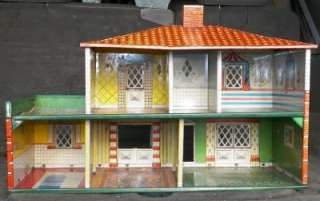
I remember some of the big presents over a number of years — the toboggan, the sled, the skates, all the dolls. I have a special memory of the dollhouse. How I loved sitting at its back open wall, spending hours moving the family members and their furniture around from room to room, imagining interesting lives and activities for all of them. This was in the days before everything was made of plastic and my dollhouse was made of tin. It was simple but wonderful. But as we're so fond of reminding one another — and especially reminding the children — it's not the gifts we remember, it's the magic. The magic for me was all about Santa Claus. I know there's some controversy these days about whether it's good to deceive your children by letting them believe in Santa. I don't think anyone could have stopped me from believing in Santa so it was never an issue for me.
I believe in him still. Nowadays, when I creep down the stairs on Christmas morning and see the fat, bulging stockings, the old magic returns and I feel the same way that I did all those years ago. It's even more interesting and magical when you consider that I filled those stockings myself, before I went to bed.
Have a happy and blessed Christmas and a wonderful 2014.


Sunday, November 26, 2017
Betty Peterson: Full-time worker for peace and justice
Betty Peterson, 77, is an activist for peace and social justice. During the Persian Gulf War, she kept a peace vigil for 88 days in front of the Halifax Public Library. In 1993, she was an organizer of a weekly demonstration of Women In Black to express solidarity with the raped women of the former Yugoslavia.
She and her husband Gunnar emigrated to Nova Scotia from the United States in 1975. Gunnar died after they had been here one year.
This story, which first appeared in The Women's Almanac in 1994, is in Betty's own words.

We lived in Chicago for 23 years where we both became very much involved in the civil rights movement – in community work, community development, teaching people to read and write. I was active in the Women's International League for Peace and Freedom, League of Women Voters, War Resisters' League, the Fellowship of Reconciliation.
When I would pick people up at the airport, I would make it a point to drive them through the ghettoes and my kids would say, why do we always have to drive here? Why don't we drive down one of the beautiful streets? Well, I wanted people to see how terrible it could be. I think I probably overdid that.
I had been a music teacher when I first graduated; then I was married, then the war came and the kids came and then you stayed at home. Oh gosh, I was very unhappy in the middle-class bedroom community in the south of Chicago – coffee klatches, bridge parties. Those bedroom communities are terrible.
Gunnar always had very exciting, demanding jobs – organizing people, helping people – and I just sat at home, talking baby talk. I had to get out.
So I got involved again. I was holding two almost full-time jobs – one with blacks, heading up a literacy centre, recruiting teachers. Then I worked at teaching English. There were Vietnamese brides coming back, people from Europe still coming over and no one to teach them, so I took the old idea of Frank Laubach, one of my heroes, with the worldwide literacy program – each one, teach one – and began working up my own materials.
Looking back now, I realize how I would call home and tell Gunnar that I wouldn't be able to make it for dinner and he'd have to take over. He was always wonderful but I felt guilty. It was years before I realized that this was the beginning of the women's movement and I didn't even recognize it.
I don't know how things went so wrong in American cities. We brought about a revolution but it didn't go far enough; there weren't enough people committed and we didn't come up with the support services to help people implement change. I don't even want to visit the States any more and that's my native land.
We had such hopes that the ghettoes were going to break down and those great apartment complexes were going to save the world. They did just the opposite.
Well, we fought for civil rights, fought against the Vietnam war and then the Watergate story broke. The system was so corrupt, right through. We wanted out of it.
So we came to Canada and bought a little place in Cape Breton – we used to come up in the summers. After Gunnar died, I decided I was going to live up there and make it on my own. But after a few years, I realized I'm a people person and I had to get active again in the world. So after a series of events and meeting good friends and social activists, I came to Halifax.
My exposure to Voice of Women, to the women's movement and to people who believed in the same things I do just opened everything up to me.
Betty with long-time friend, ally, fellow Quaker, fellow Voice of Women member, Muriel Duckworth. I also became very active again in the Quakers. Back during the Second World War, I became exposed to the Quakers. They suited me. I got tired of standing up and sitting down, singing hymns, reading scripture and all that. I wanted something that was more challenging and robust and interior too – more meditative. Quakerism fit me like a glove.
Among other things, Quakers are against war and for anti-violence. The main thing is the belief that there's not much point in faith without work. You put into practice what you believe – you don't just go to church on Sunday. So I began working with Canadian Friends Service Committee and then I was asked to serve on a National Native Committee. I'd never worked with Natives. As I got heavily involved, I travelled to other parts of the country and I began to realize that the time for Natives had come – just as the time had come in the States for the civil rights movement.
My first heavy duty involvement was with the Innu. I was asked to go – as a Quaker – to a Native assembly in Sheshatshit, Labrador. And here was the ghetto all over again – people forced to live away from their usual style of life in unbelievably awful conditions. I had never been to the ghettos in the south so this was really my first experience with terribly deprived conditions in a rural setting.
I had never seen real Third World conditions but this was it. Since then, I've been to Labrador six times, always working for the Innu. When I realized for the first time the Innu elders and chiefs were getting together to tell their stories to each other, in their own language, of their experience with low-flying aircraft, it grabbed me and when they said go back and tell people what's going on here, I took that message literally.
People have come to realize that there are no single issues, that they're all connected – peace, social justice, the environment, women's issues – and we realized that there is a different way of going about things. The way Natives go about things is so similar to the way women have come to see things. And the way Natives worship is so close to my interpretation of Quakerism.
Native spirituality came to mean a great deal to me. My first introduction to it was going into Native prisons when, because of my being known as working with Natives, I was invited to go to the native brotherhood meeting in Dorchester Penitentiary. When I saw some of the Native women and men working with prisoners at Dorchester and Renous and Springhill, that was eye-opening for me.
I'm very much interested in how people are working for alternatives to violence. I'm encouraged by Native people talking about taking back their own justice system. The jails are filled with Native people, many of whom can't relate to our system. They don't even have a word for lawyer or for offender. So turning it back to the community and giving them the power is a wonderful thing.
I sometimes joke in a bitter way and say that all my life I've believed in the coming revolution. I remember back in the early '40s hearing Norman Thomas, the great socialist, speak. He said, don't think this war is going to be the end – which we all did. We thought we were going to have a better world when the war was over. He predicted that we would live to see the Third World War – between blacks and whites, or between the poor and the rich. Oh, the shudders and gasps that went through that audience. Well, I'm afraid it's going to come true if we don't continue to work for change.
What can we do, what can we do about it? We have to face the fact that people who have worked so hard for non-violence and peace and love and understanding, we have to admit that we're stymied right now. How do you stop the carnage around the world? It's absolutely overwhelming.
I think we just have to be as loving and caring and supportive to other people around us as we can. I think we have to work at building community – sounds old hat, everybody says it, but I've come to believe that's what we have to do, until we get through this period.
