In the summer, William and a bunch of friends went to Montreal for Osheaga, the big music festival on the old La Ronde/Expo '67 site. They all got there by different modes of transportation — William drove up with a couple of guys in a van, leaving Halifax in the late evening and driving all night. Some of the other guys flew in or drove with other people. Once they got there, they all joined together and lived in a pre-arranged apartment.
They had a grand time at Osheaga. They had been at Evolve in New Brunswick just a couple of weeks before and I think if William had to choose, he might choose Evolve just because Osheaga was so big.
Here's a small part of the Osheaga crowd — a photo I borrowed off the Internet.
But it was great; they heard some good music and got lots of sun and enjoyed themselves a lot.
When it was over, some of the guys had to go home, including the ones that William had driven up with. But as it happened, William and a couple of his closest friends decided they'd like to have a couple more days in Montreal — and who wouldn't? So they settled in and did some sight-seeing and played tourist.
A few days later, he texted me. "Where do we get the train?" William has taken trains in Italy, France, Germany, Belgium and England. In any of those places, his question would have made perfect sense. I would look it up, tell him which station to go to, tell him what time the trains were leaving.
Unfortunately, in our country it's not simple. I told him to go to Central Station under the Queen Elizabeth Hotel, go to the ticket office and see what he could find out. It was Thursday.
When he got back to me, he said, "No train today. The train tomorrow is sold out."
I had checked it out by that time: departures from Montreal Wednesday, Friday and Sunday. Three trains a week.
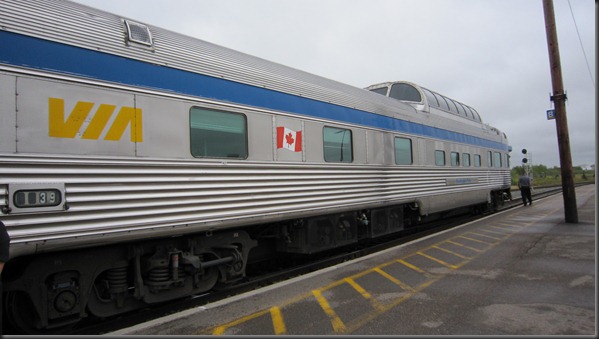
I take this quite personally. This train — the Ocean, formerly the Ocean Limited — played a significant part in my life. I lived in Montreal as a young woman and I travelled back and forth on that train several times a year. I was on a first-name basis with the porters and the sleeping car staff.
This is one of my most-used photos, I'm sure you'll agree.
I use this one too for winter stories:
I not only travelled by train but I took people to the station and waved them off and I met people who were coming to visit.
The train was there and we assumed it would always be there.
People accuse former Prime Minister Stephen Harper of saying, "Give me 20 years and you won't recognize this country." But Stephen Harper didn't say that. It was Brian Mulroney — Prime Minister from 1984-1993 — who said that. I remember him saying it because I very clearly remember thinking, "Why wouldn't we want to recognize our country?"
Mulroney did a lot of damage to this country and one of the things he did was decimate our train service. In October of 1989, the New York Times reported it this way with the headline Trains To Be Cut In Canada.
Even today, all these years later, the details are shocking to me:
TORONTO, Oct. 4 — The Canadian Government said today that it would cut passenger train service by more than 50 percent nationwide, touching off bitter protests in a country that was stitched together by railroads in the 19th century and where trains and the people who ride them are the stuff of national folklore.
The cuts, from 405 trains a week to 191 in the heavily subsidized rail network, had been expected for months because of Government budget cuts. . . The Government-owned Via Rail Canada Inc. would end up offering little more than skeleton service in wide areas of the Maritime Provinces, along Canada's Atlantic coast, and in the western provinces of Manitoba, Saskatchewan, Alberta and British Columbia. Northern Ontario would be hard hit, too, as would parts of Quebec. . . More than 2,700 of Via Rail's 7,300 employees would lose their jobs as a result of the cuts, but a confidential Via Rail report, copies of which were leaked to Canadian newspapers, said that nearly 60,000 Canadian jobs depended on passenger rail services, nearly 30,000 of them in tourism, and that many of these might be in jeopardy, too. . . Mulroney said the cuts would be irreversible and he was right. In many places, the tracks were pulled up promptly. In other places, they've grown over with weeds poking up between the ties and the rails rusted and broken. He stressed, over and over, that this was all about money. We couldn't afford our trains.
But getting rid of the trains was not good transport policy. I'm sure the research has been done (I'm not going to look it up right now) that shows the loss of our freight trains and the vast increase in the use of tractor-trailers on the highways has not been a more efficient or a cleaner alternative.
As for passenger service, William's is only the most recent story. There are many stories throughout rural Canada where the loss of rail service went far beyond inconvenience.
William got a flight home to Halifax, by the way. It was cheaper than the train ticket would have been.
And that's a whole other story.



Thursday, September 15, 2016
There was a time in this fair land when the railroad did not run

Tuesday, May 3, 2016
Love is the sweetest thing. . . Part two
There was a great atmosphere on the station platform around the people meeting the train. Most of the people getting off the train were excited too. There were little children jumping down the steps running to meet grandparents and there were student-aged young people, happy to be home but too cool to let their parents see that.
I waited back near the station door — I thought he would probably be among the last off. The crowd on the platform had begun to disperse; there were a couple of stragglers who jumped off well after everyone else. There were a few people getting on and they mostly waited until the coast was clear. I could see the conductor checking his watch and getting ready to make his legendary announcement. "All aboard!"
I could tell there was no one else getting off. He might like to tease a little by hanging back but he was not cruel and he wouldn't put me in that position. The conductor gave me a little wave and swung himself up into the coach.
The train pulled away and there I was, all alone on the platform.

I drove home and acted as casual as I could. Well, I said to Mum and Dad — after explaining that I was indeed, alone — something must have happened. We'll just have to wait and see.
The minute the long distance rates changed — 7:00 p.m., our time — our phone rang. There he was, contrite and sweet, begging me to understand that something had come up and he simply couldn't get away. He said things had straightened themselves out and he'd definitely be on the train the next day and I should expect him the day after. We chatted a bit although it was a little uncomfortable. He tried to make me feel better and said he could hardly wait to see me.
That's how I reported it to Mum and she was tactful enough to not say anything.
Two days later, I went to the station again. I parked in the same place but when the train pulled in, I stayed in the car. I watched all the activity of people coming and going and when the train pulled out, I backed out of the parking lot and headed home. You can understand, of course, that this was not only puzzling but also humiliating.
My mother was very nice. She didn't ask a lot of questions — I just brushed it off and said something was going on that I hadn't figured out but I'd definitely bring her up to speed when I had enough information.
He called again that evening. He wasn't so much contrite and sweet as he was sheepish and embarrassed. He said he knew how I must be feeling. He said he loved me and missed me. He said he would be on the train the next day, come hell or high water, and although our New Brunswick time would be shorter than planned, at least we could make a few memories together.
I told Mum a bit about the conversation but I omitted the part about his saying he'd be on the train the next day.
The next day, I made up an errand I had to run when the train was due and once more, I drove to the station. I didn't park in the regular lot where the others were parked. I pulled in down the road a bit where there was cinder underfoot, not pavement.

I waited, as I had waited twice before, then I drove home. I stopped and bought a pair of nylons in the 5 & 10. I never said a word to my parents about my third trip to the station.
There was no phone call that evening.
A few days later, Dad drove me to the station. I got on the train, smiled and waved, and went back to Montreal.
(Sorry. I'm afraid I'll have to ask you to come back one more time.)
(Here's part three.)
Monday, May 2, 2016
Love is the sweetest thing. . .
I was still living in residence so our relationship was built around my inconvenient nursing hours and my student curfew. I think it was likely that we didn't have much money — I certainly didn't and he was quite new at his job — and we spent a lot of time walking around the streets in downtown Montreal, stopping for coffee, sitting on a bench under a tree.
He was very good company: he was funny and easy-going and he seemed to enjoy doing things that would please me.
We often went to eat in one of the downtown St. Hubert BBQ restaurants. There was one on Ste. Catherine, just west of Guy St. which we often went to; this one was a few blocks east of there, on Peel St.

The food was, it certainly was, memorable. Mmmm. . . that sauce was so good.

When the weather wasn't good or when we had run out of places to be, we'd often sit and talk in one of the "beau rooms" in my residence at the General. A beau room was comfortable, furnished with a couch and chairs and table lamps. The door had a window in it and supervision was never far away. Your feet were expected to remain on the floor.
He didn't have an apartment but he was expecting to get one and in the meantime, he was staying with some people and couldn't comfortably have guests over.
He did take me to see his office in the Y building and he introduced me to his boss. We spent a short time socializing and had a nice time there.
One evening, sitting in the St. Hubert, he told me he'd bought me a gift. I think it was an occasion — maybe our monthiversary — and he slid a small bag across the table. It was a book, a vintage edition of Tennyson's Collected Poems. He knew I liked poetry and he'd really made an effort.

Edited to add: When I first published this story, I had mislaid the book and I used a generic Internet photo of a Tennyson book. The book has been found and this is it.
Several weeks after we had begun dating, I was booked to go into hospital for a tonsillectomy. This is considered a fairly serious procedure for an adult; I had been working up until my admission and had been on a course of antibiotics to get my tonsils down to a normal size for removal. He insisted that he would be coming to the hospital to see me post-surgery which I tried to discourage as I could only imagine my swollen face, lack of voice, puffy eyes. But he did come and he sat beside me, holding my hand while I was in and out of consciousness.
I had long-standing plans to go home for a month to New Brunswick — Chatham-on-the-Miramichi — to recuperate from my surgery. He said that he could get some time off and suggested that he would like to come to NB to visit me. Of course I said yes and we looked at a calendar and arranged that he would come by train toward the end of my month and we would travel back together.
We spent a couple of sad days anticipating our separation, then he took me to the station. Before I went down the stairs to the train level, he held me tenderly and said the time would go fast and we'd see each other soon. I remembered an errand I hadn't run and I gave him $40.00 and asked him to go to a Park Avenue tailor to pick up my MGH blazer which had been custom-made and was waiting for me. He happily agreed and off I went.
Life was stale and uninteresting at home but the one thing that kept me going was his correspondence. I had three letters from him in the time leading up to when we'd see each other again. His letters — I still have them too! — were sweet and often hilarious. He was Jewish and he had decided that when we got married, we should have two kids that we'd name Golde and Moishe. He filled his letters with little drawings and fantasies about our life together.
The day I was going to the train station to pick him up, I was both nervous and excited. My mother didn't help. She wasn't really looking forward to this visit although she was willing to go through with it and I knew she'd put on a hospitable act.
It was a warm, sunny, perfect day. I drove to Newcastle to the train station and parked where I could see the platform and where the passengers would be disembarking. I was calm and waited patiently. I heard the train whistle and saw other people who were meeting passengers get out of their cars and start to assemble on the platform.
The train lumbered in and came to a stop. As the passengers began to disembark, I got out of my car and walked over and joined the crowd.
I'll continue the story tomorrow.
(You can read part two right here.)
Monday, April 18, 2016
The best thing I ever ate. . .
There’s a television show that airs on the Food Network called The Best Thing I Ever Ate. I’ve never watched it but I’ve seen its promo, many times. It involves Food Network chefs reminiscing about something wonderful they’ve eaten while a variety of culinary samples are paraded across our screen.
I don’t think any of their choices look particularly appealing but it’s all a matter of taste, isn’t it? Literally.
And I began to wonder what my response would be if I were asked: What’s the best thing you ever ate?
Well, let me tell you.
Years ago, on a trip to Portugal, we had landed in Lisbon late in the evening and decided to get up early and head for Faro, the capital of the Algarve, much to the south. We got to the train station just in time to be herded aboard — we heard the conductor use the word “Faro” so we assumed we were in the right car — and in spite of a crushing crowd, we managed to get a seat. A wooden seat, if I remember correctly.
We figured that once we got going, there would be some kind of vending service available — we’d had nothing to eat or drink since the night before — and we’d be able to get a cup of coffee, at least.
About 15 minutes into the trip, all the people around us began hauling food out of their bags from under their seats: spicy, garlicky sausages, cheeses, chunks of crusty bread. Bottles of red wine and water. They looked at us very kindly and offered to share their food but we didn’t really know quite what to do and we thanked them and tried to look as if we had already eaten.
The train was old and slow and a milk-run. It chugged through the Portuguese countryside and stopped at most towns and villages. If we hadn’t been in such need of food and coffee, it’s possible we might have enjoyed the scenery and the atmosphere.
At one point — I have no idea how long into the trip it was — when the train stopped, most of our fellow passengers stampeded off and returned minutes later laden with food and drinks from a platform outside the station. If only we had known what they knew!
It was early evening when the train pulled into Faro. I picture us being the only passengers getting off but we probably weren’t although many of our fellow travellers had disembarked at different stops along the way and the train had definitely emptied out. Faro seemed quiet and dusty and deserted. I felt we should have been riding in on horseback.

(This is a generic picture of Faro. It still looks quiet.)
We walked from the station to the centre of town — exhausted from sitting on those wooden seats all day and, of course, hungry and thirsty — and went into a dim little bar. The waiter brought us cold beer and we managed to communicate to him that we’d like some food too. He was solicitous but we were able to understand that the kitchen was closed. He gestured encouragingly, however, and seemed to say the equivalent of, “Just a minute, I’ll see what I can do.”
He disappeared and came back in a few minutes and placed a plate on the table. There was a crusty roll with a piece of meat inside — meat fried in olive oil and garlic. The oil was soaking into the bread — and that was it. Bread, a piece of meat, olive oil. The meat was not melt-in-your-mouth but it was not tough. It had texture and resistance. It could be chewed.


I cannot begin to describe how good that sandwich was. I can taste it to this day, as I write about it, and I can hear the crunch of that crusty roll as I bit into it. I have tried many times to duplicate it in my own kitchen but I’ve failed. I never expect to succeed.
I’ve eaten in many fine restaurants and been fed by family and friends who are excellent cooks — and I’m a pretty good cook myself. But I don’t think I’ve ever eaten anything that I remember and can describe with such relish as that simple sandwich in Faro. It’s the perfect case in point for the expression, “Hunger is the best sauce,” — which I’m interested to see is usually attributed to Cervantes in Don Quixote.
*This piece is from my archives. It was originally published at Sharon Fraser and readers have enjoyed it so I thought it was time to share it again.
Wednesday, January 6, 2016
Tell me a story. . .
He loved Robert Munsch though and Robert was very adept at getting the attention of his audience and we all enjoyed the participatory elements.
William's favourite Munsch story was Mortimer. . .

. . .as so often with Munsch, a subversive story in which the kid outwits the grown-ups and kids, of course, find this most satisfying. At the concert, Robert asked all of us in the audeience to sing "Clang clang rattle-bing-bang" in the tune we used at home. We all sang as loud as we could — kids too — and of course, everyone's tune was different and it couldn't have been funnier.
Clang clang rattle-bing-bang
Gonna make my noise all day!
I enjoyed seeing what Robert said about Mortimer:
Once I was telling stories at a school in Toronto. It was not a fun school. The principal ran around looking very mean; the teachers ran around looking very mean; and the kids ran around looking very unhappy. I don’t think anybody got along very well in that school. At the end of the day I told stories to all of the kids and when I was done the principal got up and started yelling at the kids, telling them how they were going to be quiet and go back to their rooms and not cause any trouble. When he was done talking all the kids were silent for a second and then they all started to sing, “Clang, clang, rattle-bing bang.” Well the principal was really freaked out. I decided it was time to go.
Robert asked the audience to sing together again, this time, the mother's song from Love You Forever.

I’ll love you forever,
I’ll like you for always,
as long as I’m living
my baby you’ll be.
Once again, everyone sang with a different tune but the atmosphere was much different. Many of us acknowledged that we simply couldn't read Love You Forever without dissolving into tears before we finished the book. The kids weren't impressed and didn't understand but maybe they will someday.
Living in Ottawa, we had access to TVO and it was there we became acquainted with another fellow who became a favourite: Fireman Sam. Sam seemed to be — and was — a very simple and innocent guy. The stories were straightforward and suited a small person and who wouldn't enjoy becoming familiar with a village called Pontypandy?

At that time, Fireman Sam books were not available in Canada and we had to order them from the UK. We still get an occasional email letting us know when a new title comes out. That makes us all feel a little sentimental.
In Halifax, we lived on a busy downtown street where traffic passed our front windows day and night. One of our favourite books from that time was Night Cars.
It is late at night in the city. From his father's shoulder, a sleepless baby watches the snow drift down from the sky onto the busy street below. What are all those noises? What are all those lights? His tired but patient father explains everything, from the bustle of taxis swishing through the slush to the grinding and slamming of the early-morning garbage trucks.
The book had a very moody quality and was lovely to read. It was written by Teddy Jam, the pen name of author Matt Cohen.

And there were Goodnight Moon and The Velveteen Rabbit and Katy and the Big Snow and any number of books about trucks, diggers, bulldozers and all manner of heavy equipment. Not to mention sports, fairy tales, fables, legends and the classics.
Nothing though took over every room in the house like the little blue engine called Thomas.

We first saw him on TVO as well. His ascent had begun but at that time, he was still a fairly unknown little engine. The first books we got were still the small oblong hard-cover books by The Rev. Wilbert Awdry and many of the engines had not yet made an appearance.
Thomas did get very big indeed but at our house, after the books, the trains and the tracks were all that were needed.

(We had lots more tracks than are shown in this Internet picture.)
Every day when William came home from school, a new configuration of tracks would begin to take shape. The tracks ran under the chairs and around the legs of the coffee table. They often straddled two rooms and we all learned how to get around the house without disrupting the goings-on on the Island of Sodor. In short, Thomas, Percy, Edward, Gordon, Henry, James, Emily, Rosie and Sir Topham Hatt all became valued members of the family and they all had their place.
Most of the childhood books have been given away to other children or sold at book sales for good causes. Not the Thomas books though. William decided at a certain point that he would keep them and they would accompany him on his life's journey, wherever that may take him. The books are carefully packed into a box with the trains and tracks, a few videotapes and maybe a CD, and the beautiful Thomas the Tank Engine bedspread that he slept under for much of his little boyhood.
On our recent trip to England, we were passing through the village of Stroud in Gloucester on one of our day trips with The English Bus. As we passed a row of modest houses, our guide pointed out one of the houses and said, "That's where The Rev. Wilbert Awdry lived. Some of you may have heard of him."
Oh yes. If only he knew.
Thursday, December 24, 2015
Christmas on the Ocean Limited

In the mid-‘60s, I was a student in Montreal. One year, my schedule made it impossible for me to leave for home before December 24 so there I was, deciding whether I should spend much of Christmas in a little room in residence or whether I should spend it on the train. I decided in favour of the train.
I was very familiar with Montreal's Central Station and always looked forward to the atmosphere there in the few days leading up to Christmas. There would always be a big raucous crowd at the far end of the station. Mostly everyone would be carrying shopping bags filled with wrapped gifts; there would usually be a couple of people with guitars and there'd be lots of excited children.
When that big white-on-black sign was rolled into place listing the destinations — Trois Rivières, Québec City, Montmagny, Rivière du Loup, Rimouski, Mont Joli, Campbellton, Bathurst, Newcastle, Moncton, Amherst, Truro, Halifax and Sydney — there was a cheer and a good-natured crush as we all prepared to go down the stairs and board the Ocean Limited. These were eastern Quebecers and Maritimers going home for Christmas.
It wasn't like that on that Christmas Eve. The station was dim and quiet, the way airports are late at night. There was a straggling handful of us waiting to board; we were subdued and cheerless.
It was late evening when we got on the train but even still, most of us gravitated toward the club car and soon began to talk. We exchanged stories of who we were, where we were going, why we were travelling on Christmas Eve. Some people were in my situation — they had worked up until that afternoon. One young couple had planned to stay in Montreal for Christmas and had decided at the last minute that they couldn't bear not being home.
We talked about who would be meeting us at our various station stops and about little family traditions we were missing by not being home tonight. By the time we went off to our berths and roomettes, we were feeling quite warm and cheerful, the way you do when you've made new friends.
When we congregated in the morning — a sunny Christmas morning — in CN's dining car, we were already rolling through the impossibly white snowy Québec countryside along the St. Lawrence River.
It was then that we began to lose some of our crowd and we established an instant tradition: at each station, as someone was leaving the train, all the rest of us would gather around the door to wave to the family on the platform and to sing a rousing chorus or two of "We Wish You A Merry Christmas." We just kept waving and singing until the train pulled out.
By the time we were crossing the Gaspé peninsula, heading towards northern New Brunswick, we were having a real Christmas dinner, drinking toasts to each other and to our crew and acknowledging that so far, believe it or not, we were having a pretty good Christmas.
By mid-afternoon, our numbers had dwindled and as we approached the broad sweep of the Miramichi River valley, I began gathering my stuff together to be the next one to go. At the Newcastle station, I was waved and sung off the train by fewer people than there'd been earlier but with no less enthusiasm. My mother and father and I stood on the platform watching the train out of sight as it continued on toward Moncton.
The five-mile drive to Chatham was a merry one as I reported all the details of the trip. Everyone — including me — was surprised at the exuberance of my mood, everything considered.
There was one more surprise. Although both towns had the quiet empty streets and the unmistakeable atmosphere of Christmas Day, in our own house, the calendar had been set back. They didn't want me to miss the special feeling of Christmas eve so the presents remained wrapped under the tree, the mince pies were on the counter ready to be baked, and the turkey was still in the bottom of the fridge, ready to be roasted with all its trimmings on Boxing Day.
When I'd left Montreal the night before, I had resigned myself to having no Christmas at all. I ended up having two Christmases — which turned out to be much more satisfactory.
(This piece was written and published a number of years ago. When the late Peter Gzowski was hosting Morningside on CBC Radio, he asked listeners to send him something about Christmas for his Christmas Eve program. I sent this and he read it to end his program that day. Years later, I read it myself on Christmas Eve, on the CBC Radio Mainstreet program that covered the Maritimes. I was hoping to give you a link to hear me reading it but I couldn't find it so I'm afraid you'll have to read it yourself. I hope you enjoy it and I wish you all the best of the Christmas season.)


Friday, September 11, 2015
On the wrong track

We’re just back from England where the trains and the Underground became so much a part of our day that we were close to taking them for granted. It’s a good feeling and although I can understand running to catch a train if you have an appointment or are on your way to work, for us, well . . . we hoped to catch the train but if we didn’t, another one would soon be along.

We travelled to France – under the Channel – by Eurostar and when we arrived, we also took advantage of France’s rail service.
(Four years ago, we also used trains in Italy, Germany, Belgium and France and had no complaints.)
Now I freely admit that we were there for a pretty short time and I’m sure that people who use the trains day in and day out, year after year, don’t look at the service as positively as I do. I’m also speaking comparatively.
Rail service in Britain has been privatised (I’m spelling it that way out of respect) and this process has been so complex that I won’t try to explain it. You can imagine though, trying to sell off the railways in bits and pieces – how to do it? By geography? By the age of the rails and the rolling stock? By how busy the service is?
To this day, the privatisation causes problems as in some places, just as an example, the rails and the rolling stock are owned by different companies. In a for-profit system, this can compromise safety as each company plays repairs off the other. There have been serious accidents, including a number of fatalities.
At one point after the privatisation, three of the lines went bankrupt and were re-nationalized. It’s nice to shatter the always-trotted-out myth that the private sector always runs things better than the public sector. It’s not true, of course, and in this case, after the public sector took over, the lines were safer and more efficient than their private counterparts.
I have to emphasize that the positive impression of the train service that I have is in comparison to home and that the people who use it regularly would probably guffaw reading this.
I did enjoy my train experiences though. What can I say?

In 1993, The Independent did some background on the issues around privatisation.
In 2013, The Guardian asks some pointed questions about how it’s all working.
And in 2015, Metro.UK slams the system for high fares, poor service.
So what do I know? It’s still better than home but I’d be happier if the railway system were a publicly-owned service.