Showing posts with label Shakespeare. Show all posts

Sunday, June 5, 2016

Shakespeare strikes again, as timely as ever

William Shakespeare died on his 52nd birthday. It was April 23, 1616. On April 23 of this year, 400 years since his death, his life and work were once again celebrated in his hometown of Stratford-Upon-Avon.

You may wonder — and it's worth wondering — how it could be possible to find new ways to honour Shakespeare after 400 years of continuous production of his work and of the recognition of his place at the top of the list of acclaimed writers.

They managed. Today we went to see the big-screen presentation of the show they put together for April 23. It was filmed by the BBC — shown live in the UK — and is now playing around the world.

It's a two hour and 40 minutes show and when it was over, I said, "There wasn't one minute in that production that I didn't like." This is unusual; I'm no pushover.

The show was done at the Royal Shakespeare Company Theatre in Stratford.

The stage was in the centre, the orchestra was elevated behind the stage, there were several pathways leading offstage and there were balconies which were used by the actors for certain scenes. The audience was on three sides, on several levels, all tucked in quite close to the stage.

The show included everything. Some of the critics said when they heard there would be "something for everyone," they cringed and expected a "low-brow" evening of dumbed-down Shakespeare. That's a pretty snobby attitude but anyway, that's not what happened.

What they wanted to show us was Shakespeare and the wide and often direct influence he had on culture throughout the ages. The show included amazing scenes from the plays and beautiful and often touching renditions of the songs. But it also included broad comedy, high drama, Broadway music and dancing, ballet, opera, jazz, hip hop and Rufus Wainwright.

Each piece was either direct Shakespeare or a story inspired by his genius: West Side Story from Broadway, for example; Brush Up Your Shakespeare from Kiss Me, Kate (The Taming of the Shrew); a Duke Ellington composition inspired after he saw a play at Stratford in Ontario (Canadian content!); the pas de deux from the ballet Romeo and Juliet which followed the balcony scene from the play. When the dance ended, we could see Romeo and Juliet from the play, up on the balcony, watching with us.

A funny scene that got a lot of publicity at the time involved the well-known soliloquy from Hamlet. The current Hamlet from the Royal Shakespeare Company had begun to recite it when a director came out and made a suggestion about which word to emphasize — to be or not to be. The joke, which soon becomes obvious, is that more and more Hamlets begin to appear, all to offer their two-cents worth about which word to emphasize.

By the time they've all appeared, Paapa Essiedu has accepted advice from Tim Minchin, Harriet Walter, David Tennant, Benedict Cumberbatch, Rory Kinnear, Ian McKellen and Judi Dench — Hamlet the Dame, she declares.

But the final advice is yet to come. It may be considered that the Prince of Denmark could be well-played by the Prince of Wales and indeed, he was there and he joined the advice party.

You'll be glad to know that after the fun, all the Hamlets except Paapa Essiedu left the stage and he delivered the soliloquy with heart-touching feeling.

The show was efficiently run and well-paced. The hosts were David Tennant and Catherine Tate. They did a lovely job. (She looked very familiar to me and I couldn't place her until I got home and looked her up. She played Nellie in the American version of The Office.)

Helen Mirren made a short appearance near the end as Prospero from The Tempest:

Our revels now are ended./ These our actors,/ As I foretold you,/ were all spirits and/ Are melted into air,/ into thin air. . .

And David Suchet (best known as Hercule Poirot) and Judi Dench appeared as Oberon and Titania from A Midsummer Night's Dream as the celebration ended.

There was so much more. I could sit here for hours, telling you every detail of the show. I won't though but if you can get to see it, I recommend it. I can't imagine that you wouldn't enjoy it.

Thursday, November 26, 2015

Back to Shakespeare

We went to see The Winter's Tale this evening, another filmed London stage play. It was broadcast live to Europe and we saw it on a bit of a delay.

As we were leaving, some people sitting around us said, in our general direction, "If you ever get a chance, tell us what that was all about!" They were laughing but they seemed to imply they'd had a hard time following it.

Dan and I enjoyed it. I had a short text exchange with William during intermission and he said, "How's the play, Mum?" I said, "It's intense Shakespeare."

And it was. You really needed to focus; if your mind wandered, you were in danger of losing the thread.

The acting was superb. A Reuters story said this:

Her cutting words were written by William Shakespeare, but the withering stare the straight-talking Paulina focuses on co-star Kenneth Branagh's insanely jealous King Leontes in a new production of "The Winter's Tale" is pure Judi Dench.

Dench's stare, at the end of the first half, has had audiences sitting on the edge of their seats since the Kenneth Branagh Theatre Company's production of Shakespeare's late-life portrait of the wreckage wrought by jealousy opened this month.

It is a "moment I shall long remember," Guardian critic Michael Billington wrote.

The play is thought to be one of Shakespeare's later works and was first performed in 1611. It's not performed as often as many of his other works but it's getting a warm reception in London right now.

During intermission, we were amused by a recitation of Bernard Levin's Shakespearean quotes. Here it is although it's probably more fun to listen to than to read yourself.

On Quoting Shakespeare

If you cannot understand my argument, and declare "It's Greek to me,"

you are quoting Shakespeare;

if you claim to be more sinned against than sinning,

you are quoting Shakespeare;

if you recall your salad days,

you are quoting Shakespeare;

if you act more in sorrow than in anger;

if your wish is father to the thought;

if your lost property has vanished into thin air,

you are quoting Shakespeare;

if you have ever refused to budge an inch or suffered from green-eyed jealousy,

if you have played fast and loose,

if you have been tongue-tied, a tower of strength, hoodwinked or in a pickle,

if you have knitted your brows,

made a virtue of necessity,

insisted on fair play,

slept not one wink,

stood on ceremony,

danced attendance (on your lord and master),

laughed yourself into stitches,

had short shrift,

cold comfort or too much of a good thing,

if you have seen better days or lived in a fool's paradise

why, be that as it may,

the more fool you,

for it is a foregone conclusion that

you are (as good luck would have it) quoting Shakespeare;

if you think it is early days and clear out bag and baggage,

if you think it is high time and that is the long and short of it,

if you believe that the game is up and that truth will out

even if it involves your own flesh and blood,

if you lie low 'till the crack of doom because you suspect foul play,

if you have your teeth set on edge (at one fell swoop) without rhyme or reason,

then - to give the devil his due - if the truth were known (for surely you have a tongue in your head)

you are quoting Shakespeare;

even if you bid me good riddance and send me packing,

if you wish I was dead as a door-nail,

if you think I am an eyesore,

a laughing stock,

the devil incarnate,

a stony-hearted villain,

bloody-minded

or a blinking idiot,

then - by Jove! O Lord! Tut tut! For goodness' sake! What the dickens! But me no buts! - it is all one to me, for

you are quoting Shakespeare.

Tuesday, November 17, 2015

Hamlet-the-character: regularly redefined

Benedict Cumberbatch’s Hamlet was playing in London while we were there recently. We had checked on tickets before we ever left home but tickets had sold out in an hour a full year before the play opened. There were 30 tickets made available for each performance when we were there – first come, first served – and people were sleeping overnight on the sidewalk in front of the theatre hoping to score. We weren't among them.

The production didn't get good reviews but Benedict got rave reviews for his portrayal of Hamlet.

However, we did see it in the end, in a movie theatre in downtown Halifax. This was a filmed version of the stage production. We had read all the negative reviews but we weren't deterred from seeing it. I'm glad; I was blown away by it.

Before it started and during intermission, you could see the audience going in and out, getting some wine and snacks, stretching their legs (it was over three hours!) etc. That was fun – it was a little like being there.

Benedict is a wonderful actor – and must be exhausted by the end of it. He plays Hamlet with great energy and bravado. It is one of the most-produced plays of all time and I'm sure I'm just the latest in a long long line of people to say that Hamlet-the-character is regularly redefined by the last actor to play him. Over the last few days, I've watched (thanks, YouTube!) some of the actors who have risen to the occasion and who've been acclaimed for their performances. I found them all so different from each other.

John Gielgud played Hamlet anguished; Richard Burton – determined and confident; Laurence Olivier – forlorn and sad; David Tennant – a little bewildered. Hamlet, it seems, is whoever the actor portraying him decides he is.

After the curtain call at the theatre in London, Benedict always stepped forward and talked to the audience about the refugee crisis in Europe. He asked the audience for donations to help the refugees and by the end of the run, he had raised a lot of money for the cause. He spoke to us in the movie theatres after his performance also and was eloquent in his plea for people to help in this humanitarian emergency. He quoted an excerpt from the poem Home by Warsan Shire.

no one leaves home unless

home is the mouth of a shark

you only run for the border

when you see the whole city running as well

your neighbors running faster than you

breath bloody in their throats

the boy you went to school with

who kissed you dizzy behind the old tin factory

is holding a gun bigger than his body

you only leave home

when home won’t let you stay.

no one leaves home unless home chases you

fire under feet

hot blood in your belly

it’s not something you ever thought of doing

until the blade burnt threats into

your neck

and even then you carried the anthem under

your breath

only tearing up your passport in an airport toilets

sobbing as each mouthful of paper

made it clear that you wouldn’t be going back.

you have to understand,

that no one puts their children in a boat

unless the water is safer than the land. . .


You can read the rest here.

Monday, September 28, 2015

4.9 million is just a number

It’s pretty darn hard to criticize the business of tourism and the presence of millions of tourists when you’re one of them. That’s my dilemma as I think back to several travel destinations and locations over the past few years.

We recently visited – for obvious reasons – Stratford-upon-Avon. It’s the birthplace of one William Shakespeare and because of that, 4.9 million people visit the town every year.

Many of them were there the same day we were.

(As always, a reminder to click on the photos to get the enlarged version.)

I don’t really mind the crowds. I feel safer when there are lots of people around – pickpockets aside – and in some of these famous places, I don’t mind lining up or being jostled around.

I’m a bit of a hypocrite though because I recognize the climate change threat of millions of people flying all around the world and I can understand the damage control that officialdom is forced to take in order to preserve ancient works of art from millions of hands and feet all of which are out to despoil valuable antiquities.

I suppose my point is that I think it should be okay for me to travel to wonderful places but other people should stay home.

Imagine what it would have been like at the Spanish Steps in Rome if only I – and maybe a few other deserving people – were there on this day a few years ago.

Having said all that, Stratford is a lovely town and tourism has given the people there a better life than they would have if they had to depend on call centres and the other small businesses that are non-tourism related. Many towns in England are not doing well and by comparison – in fact, even without making any comparisons – Stratford is doing very well indeed.

The house where Shakespeare was born and grew up is still there and some of it is the way it was when he was there. There is something thrilling – it’s almost child-like – about walking on a floor and knowing that William Shakespeare himself walked there. Don’t ask me why.

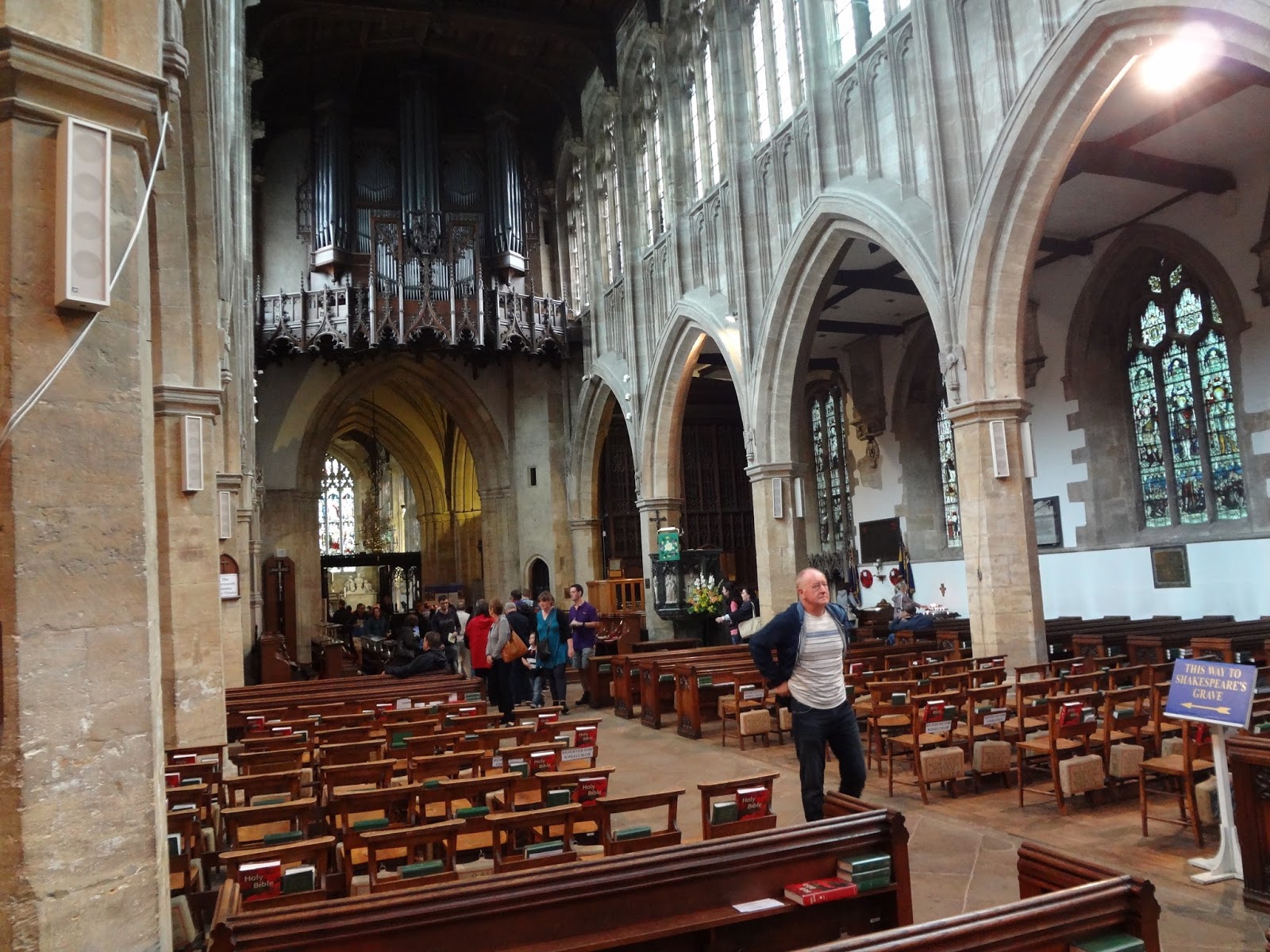
Shakespeare was baptized, married and buried in Stratford.

I don’t want to come off sounding disillusioned about Stratford. It’s a beautiful town and I very much enjoyed visiting it – crowds or no crowds.

It was raining but we did the walking tour anyway. Look how pretty this is.

Sunday, September 27, 2015

All the world's a stage (2)

This is the garden behind the house where William Shakespeare grew up in Stratford-upon-Avon. I was walking here, admiring the lushness and the flowers when I turned and saw a man in a wheelchair a few steps away from me.

I smiled at him. He looked at me intently and said, “Is there something I can do for you?”

He watched me patiently while I considered his question.

“The ‘tomorrow and tomorrow and tomorrow’ soliloquy from Macbeth,” I said.

He lowered his head and looked at his hands for several seconds. When he looked up again, he was a different person. He began to speak in a low anguished voice.

There would have been a time for such a word.

Tomorrow, and tomorrow, and tomorrow,

Creeps in this petty pace from day to day

To the last syllable of recorded time,

And all our yesterdays have lighted fools

The way to dusty death. Out, out, brief candle!

Life’s but a walking shadow, a poor player

That struts and frets his hour upon the stage

And then is heard no more: it is a tale

Told by an idiot, full of sound and fury,

Signifying nothing.

When he finished – several other people had gathered as he spoke – we gave him a warm round of applause. He bowed modestly and turned and wheeled himself away. It was only later I wondered if I should have given him a couple of quid. Everything does seem to have a dollar/pound value these days although he didn’t look as if he expected payment.

I confess, I wasn’t completely surprised by his question. We had come to Stratford with a charming small touring business called The English Bus. Our guide had told us before we arrived that there are often actors in the grounds or in the houses, always willing to play a part.

More about Stratford and Shakespeare and The English Bus tomorrow.